






Bravo’s favorite Newlyweds Alaska & Kimberly Gedeon of BLAK Squared Media, would like to invite you and your friends to attend the first POWERforward gala...
Best online pharmacy with fast delivery order singulair online
order super cialis online



Instagram

![Former President of the Chamber of Deputies Gary Bodeau officially submitted his presidential candidacy documents on Thursday, October 29, to the Bureau Électoral Départemental (BED) Ouest 1 in the Pétion-Ville area (Route de Frères). He is running under the banner of the political platform REKONSILYE.
Bodeau, a former deputy for Delmas who previously served as President of the Chamber of Deputies, was accompanied by several other candidates from the platform, including Senator René Armstrong and artist Atros (Steevenson Telfort), who is seeking a Senate seat in the Ouest department. Dozens of supporters, including rara bands, accompanied him.
Speaking after the filing, Bodeau denounced what he described as a transition that has dragged on endlessly since the assassination of President Jovenel Moïse in July 2021. He stressed the need for Haiti to move beyond successive transitional periods and restore institutions through credible elections. His team had been preparing for a first-round vote in the first quarter of 2027. The Provisional Electoral Council (CEP) published an updated calendar on October 28 setting the first round of the presidential and legislative elections for July 18, 2027, with the second round and local elections scheduled for October 4, 2027.
On policy, Bodeau is centering his platform on security, job creation, and decentralization. He argues for redistributing economic and administrative activity away from the Port-au-Prince metropolitan area, including a proposal for two capitals and greater investment in the Grand Nord—particularly the economic and tourism potential of Môle-Saint-Nicolas and Île de la Tortue. He has also previously floated the idea of shifting significant capital functions toward the Nord-Ouest department.
REKONSILYE, which groups several parties and organizations (including elements of KID, MUR, KAD AYITI, and others), selected Bodeau as its presidential candidate in mid-September after an internal vote. He had already registered online with the CEP in September. Bodeau’s candidacy comes amid a crowded field of more than 20 registered presidential aspirants.
#lunionsuite #haitianamerican #haitian]()
![For the first time, Haiti’s government has allocated 50 million gourdes (approximately $382,000 USD at current exchange rates) to the Vodou sector as part of the national budget adopted on September 30. The announcement was made on Wednesday, October 28, by Minister of Foreign Affairs and Religious Affairs Raina Forbin during a meeting in Port-au-Prince with Vodou leaders.
According to the Ministry of Foreign Affairs and Religious Affairs, the allocation places the Vodou sector on the same footing as other religious denominations recognized in Haiti. The funds, approved by the Council of Ministers under the leadership of Prime Minister Alix Didier Fils-Aimé, are intended to support collective-interest initiatives that benefit the sector.
The meeting focused on the modalities for using the support fund and on strengthening dialogue between the state and representatives of the Vodou community. Forbin also welcomed the recent swearing-in of twelve houngans and mambos before the Court of First Instance of Port-au-Prince. She described the step as important progress in the implementation of the presidential decree of April 4, 2003, which recognized Vodou as a religion in its own right.
The minister further announced that the national Ati is now among the individuals eligible for certain state protocol privileges, including access to a diplomatic passport, in accordance with the decree of June 2, 2026.
Vodou leaders expressed satisfaction with the advances and welcomed Forbin’s engagement in dialogue with the sector. They also shared concerns and proposals aimed at better structuring the community. Participants agreed to hold a follow-up consultation meeting.
Forbin reaffirmed the government’s commitment, under Prime Minister Alix Didier Fils-Aimé, to strengthen dialogue with religious leaders across the country and to ensure Vodou receives the same consideration as other state-recognized faiths. The ministry framed the measures in terms of institutional equity, mutual respect, and the valorization of Haiti’s cultural and spiritual heritage.
#lunionsuite #haitianamerican #haitian]()
![President Donald Trump publicly confirmed he has spoken with El Salvador’s President Nayib Bukele about the situation in Haiti, telling the Salvadoran leader to handle the crisis as he sees fit. Speaking to reporters at a Halloween gathering at Mar-a-Lago on October 31, Trump said Bukele described having “a big problem with Haiti” and that “they killed some of his people.” Trump responded: “You’re running your country. You have to do what you have to do.”
Bukele later confirmed the exchange on X with a simple “Can confirm.” in reply to a White House Rapid Response post of the clip. Trump also stated that Bukele “doesn’t need help” and is “in pretty good shape,” signaling no immediate U.S. military involvement.
The comments come as El Salvador has rapidly deployed more than 2,000 troops to Haiti following the October 18 ambush of four Salvadoran aviation technicians serving with the UN-authorized Gang Suppression Force (GSF). The men were returning from a supermarket in the gang-controlled Croix-des-Bouquets area near Port-au-Prince when their armored vehicle was attacked with gunfire and explosives. They escaped the burning vehicle but remain missing. No gang has claimed responsibility, and official statements continue to treat them as unaccounted for rather than confirmed dead.
Bukele has framed the operation as a rescue mission and an effort to “teach the gangs a lesson,” while insisting it is not an invasion or an action against the Haitian people. In messages posted in Kreyol, he stated that El Salvador has no interest in dominating Haiti or seizing its resources, that the country is covering roughly 90% of the costs, and that the troops will return once the mission is complete.
The deployment has drawn scrutiny. A Haitian diaspora advocacy group has alleged civilian casualties and airstrikes in areas near Port-au-Prince; Bukele has denied the claims, noting that Salvadoran attack helicopters only arrived later and that the mission does not involve bombs. The situation remains fluid, with search operations ongoing and questions about the scale and duration of El Salvador’s presence still unanswered.
#lunionsuite #haitianamerican #haitian]()
![Economist, university professor, and entrepreneur Etzer Emile formally announced on Saturday, October 31, his candidacy for the presidency of Haiti under the banner of the political grouping Gwoupman Solèy (also referred to as SOLEY). The announcement came via a video statement and a campaign communiqué.
Emile, who has long analyzed Haiti’s economic and institutional challenges through teaching, writing, and public commentary, frames his run around three core priorities: security, jobs, and social justice. In the statement, he said improving security is the essential precondition for restoring public confidence, economic activity, and access to basic services. “The problem is not the truck. It’s the driver model that needs to change,” he stated, arguing that the country needs a government capable of protecting citizens, stimulating wealth creation, and remaining accountable.
On security, Emile proposes strengthening the country’s security and justice institutions, improving intelligence capabilities, combating the illegal circulation of weapons, and tightening border controls, while respecting the law and human rights. He has said families should be able to live without fear and workers should be able to move freely.
For employment and economic recovery, he calls for infrastructure development and administrative and tax reforms aimed at attracting local and foreign investment across industry, agriculture, tourism, commerce, and renewable energy sources such as solar and wind. On governance and social justice, he pledges to end patronage-based hiring in public administration, publish state expenditures, combat corruption and impunity, ensure equal treatment of citizens, and protect women against violence and discrimination. He also emphasizes greater participation for Haitians in the provinces, the diaspora, and people with disabilities.
Born on September 1, 1985, in Cavaillon, Emile is 41. He is married and the father of two boys. He studied economics at Université Quisqueya (where he teaches) and sociology at the State University of Haiti, then earned an MBA in finance and banking in Taiwan.
#lunionsuite #haitianamerican]()
![American Airlines officially returned to Haiti on Sunday, November 1, with the arrival of its first commercial flight at Cap-Haïtien’s Hugo Chávez International Airport. The move ends nearly two years of suspended operations by major U.S. carriers in the country.
Flight AA2492 departed Miami International Airport aboard a Boeing 737 aircraft and landed in Cap-Haïtien, marking the resumption of regular commercial service. The inaugural flight operated with an all-Haitian crew. Airport officials organized activities to mark the occasion at both ends of the route, with inaugural events planned in Miami and Cap-Haïtien.
The airline is now operating daily nonstop service between Miami and Cap-Haïtien using Boeing 737 aircraft. Typical schedules show morning departures from Miami around 10:15–10:20 a.m. arriving in Cap-Haïtien around 12:15–12:28 p.m., with the return flight departing Cap-Haïtien in the early afternoon and reaching Miami mid-afternoon.
The airline had announced the November 1 restart earlier in the year, becoming the first major U.S. carrier to formally restore regular commercial flights to Haiti since the late-2024 suspension.
U.S. commercial service to Haiti was largely halted in late 2024 after multiple incidents in which commercial aircraft were struck by gunfire near Port-au-Prince amid the country’s gang-related security crisis. The U.S. Federal Aviation Administration imposed restrictions barring U.S. carriers from the capital’s Toussaint Louverture International Airport; those restrictions on Port-au-Prince remain in effect. Cap-Haïtien and other northern airports were cleared for service, allowing this return.
American previously operated to Cap-Haïtien for years before broader suspensions. Haiti had been the only Caribbean nation without direct U.S. carrier flights during the suspension period. Regional operators continued limited Miami–Cap-Haïtien service in the interim.
#lunionsuite #haitianamerican #haitian]()
![Fèt Gede, the Festival of the Dead, is one of the most sacred and powerful celebrations on the Haitian Vodou calendar. Held every year on November 1 and 2, All Saints’ Day and All Souls’ Day, it is a time when families and Vodouists gather in cemeteries across Haiti to honor the ancestors with offerings, rituals, drums, and the signature banda dance.
Also known as the Festival of the Ancestors, Fèt Gede (Fèt = Festival, Gede = the sacred dead) is far more than remembrance. It is a living conversation between the living and those who came before us. The Gede, the family of lwa who guard the threshold between life and death, are both fierce and joyful. They remind us that death is not an ending, but a continuation; that the ancestors still walk with us, guide us, and strengthen us. In their presence, the boundary thins, and the community reconnects with the roots that have sustained Haiti through every trial.
Often described as Haiti’s equivalent of Mardi Gras, Mexico’s Day of the Dead, and Halloween rolled into one, Fèt Gede carries its own deep truth: life and death, joy and sorrow, fertility and finality exist together. It is a celebration of resilience, of lineage, and of the unbreakable bond between the living and the dead.
📸 @verdyverna
#lunionsuite #haitianamerican #haitian]()
![Haitians Honor Their Ancestors Through Fèt Gede, a Two-Day Celebration of Life, Death, and Tradition
Every year on November 1 and 2, Haitians in Haiti and across the diaspora observe Fèt Gede, one of the most meaningful celebrations in Haitian Vodou. It is a time to honor loved ones who have passed away, remember our ancestors, and celebrate the connection between the living and the dead.
During Fèt Gede, Vodou practitioners gather at cemeteries to pray, light candles, make offerings, and pay their respects. Some wear black, purple, and white, while others celebrate through music, dancing, and traditional ceremonies.
At the heart of the celebration are the Gede spirits, who are associated with death, ancestors, and the cycle of life. Baron Samedi and Manman Brigitte are among the best-known spirits connected to these traditions.
While Fèt Gede takes place around the same time as All Saints’ Day and All Souls’ Day, it has its own deep roots in Haitian history, spirituality, and culture.
For many Haitians, Fèt Gede is more than a day of remembrance. It is a celebration of those who came before us and the traditions that continue to connect generations.
#lunionsuite #haitianamerican]()
![New York City Mayor Zohran Mamdani said Saturday that President Donald Trump has agreed to grant an immediate visa to the mother of 15-year-old Javits Frimpong after a phone call between the two.
“The murder of a child is a pain no parent should have to endure, let alone from thousands of miles away,” Mamdani posted on X. “Javits Frimpong’s mother deserves to say goodbye to her son in person. I just got off the phone with President Trump and he has agreed to grant her visa immediately. All of New York City is mourning this tragedy.”
Frimpong, a Ghanaian immigrant who had moved to the Bronx about a year earlier to live with his father, was fatally shot Thursday morning, October 29, while walking to school. Police said he was shot once in the abdomen near East 171st Street and Crotona Place in the Claremont section of the Bronx, shortly before 9:30 a.m. Officers transported him to St. Barnabas Hospital, where he was pronounced dead. No arrests have been made. Investigators are seeking three teenage males last seen in dark clothing and masks. The motive remains under investigation.
Frimpong’s father, Thomas Frimpong, has said his son had been bullied at DreamYard Preparatory School and that school officials had recently suspended two students in connection with incidents involving him.
Frimpong’s mother, Doris Adu Gyamfi, remains in Ghana (Kumasi). Ghana’s Foreign Minister Samuel Okudzeto Ablakwa said he had spoken with her and assigned officials to help with the visa process. He added that the Ghanaian government would cover her full travel costs and contribute toward a dignified funeral while continuing efforts to secure justice. Community members and elected officials have held vigils in the Bronx as the investigation continues.
#lunionsuite #haitianamerican]()
![At Aya Nakamura’s sold-out concerts in Montreal’s on October 24–25, the French-Malian star performed an acoustic version of her song “J’ai mal.” As the guitar began, a familiar melody cut through the room. Many Haitian fans in the audience recognized it immediately. The opening notes closely matched “Se pa pou dat,” the long-running konpa classic by Haitian singer @AlanCave.
Nakamura continued with her lyrics without mentioning Cavé or the song. Within hours, videos of the moment circulated online. Some listeners saw the resemblance as an uncredited use of a major Haitian track. Others viewed it as a possible influence or a simple arrangement choice. The clips turned into a wider conversation about recognition, cultural borrowing, and how Haitian music sometimes appears on larger international stages without credit.
“Se pa pou dat” is one of the defining love songs of modern Haitian music. The track has remained a staple for more than two decades. Its slow, emotional melody is instantly recognizable to many in the Haitian diaspora, even to those who do not speak Kreyol. Aya Nakamura, is the most-streamed French-speaking female artist in the world. Her sound blends Afrobeat, R&B, & urban pop, and “J’ai mal” is an earlier, more vulnerable song that has stayed in her repertoire.
Days later, on October 30, Alan Cavé responded on Instagram. He had attended Nakamura’s shows and also joined a master class with her musicians. During that session, he learned that her drummer and musical director are Haitian, a discovery he described with pride. He later met Nakamura and thanked her and her team for their warm welcome.
Addressing the musical moment, he wrote:
“Hearing a few notes of ‘Se pa pou dat’ blend into your ‘J’ai mal’ in the middle of your show…it touched me, but I didn’t feel any pain. Next time, we could sing it together.” He added that it was beautiful to see a song he created years ago continue its journey into another generation’s music.
Rather than focusing on the debate, Cavé treated the moment as a sign that the song is still traveling and framed the unexpected connection as an open door.
🎥 @Naishaazorr Janellesimonee1/Tiktok
#lunionsuite]()
 order synthroid online
order xifaxan online New online drugstore with no prescription
Tag - Alaska Gedeon
Haitian- American Alaska Gedeon who’s the director of Urban A&R for Atlantic Records and one of the stars of Bravo’s new show “Newlyweds...
ADVERTISE WITH US
Featured In:











While we don’t typically engage in or amplify what social media has labeled the “Diaspora Wars,” some moments ask for a conversation that goes beyond the arguments, comparisons, and divisions that often dominate these spaces.
A recent video tied to a vigil for 15-year-old Javits Frimpong, a Ghanaian teenager who was fatally shot while walking to school in the Bronx on October 29, has sparked discussion. In the days after his death, members of New York’s Ghanaian community, along with family, neighbors, and religious leaders, gathered to mourn and call for justice.
A clip circulating online captures a woman insists the moment is for Africans only. A man, identified as a Haitian American community leader, pushes back, arguing that the death of a child should be a moment for all Black people to come together. He emphasizes that the response should transcend national or ethnic lines because the violence itself does not. According to those familiar with his work, he shows up for communities regardless of whether the victim is African, Black American, Jamaican, or otherwise.
The point we believe he is making is that the fragmentation we often insist on, separating ourselves by country, culture, or ethnicity does not protect us. In the face of a child being shot, those distinctions become secondary to the fact that we are all Black people living with the same threat.
As Haitians and members of the broader Caribbean diaspora, we understand the importance of cultural pride, identity, and standing firmly for our own communities. We also recognize the weight of collective grief and the value of respecting how communities process loss and show up for their own. Social media makes it easy for a single encounter to be treated as a statement about entire groups of people. How do we hold space for our respective identities and histories without letting differences overshadow the experiences that connect us.
Our intention in sharing this is not to encourage division or set one community against another. It’s to create room for honest dialogue, different perspectives. Please keep the discussion respectful.
Sources: @Dalourny | Mssjordanofficial
#lunionsuite #haitianamerican
6 hours ago

Former President of the Chamber of Deputies Gary Bodeau officially submitted his presidential candidacy documents on Thursday, October 29, to the Bureau Électoral Départemental (BED) Ouest 1 in the Pétion-Ville area (Route de Frères). He is running under the banner of the political platform REKONSILYE.
Bodeau, a former deputy for Delmas who previously served as President of the Chamber of Deputies, was accompanied by several other candidates from the platform, including Senator René Armstrong and artist Atros (Steevenson Telfort), who is seeking a Senate seat in the Ouest department. Dozens of supporters, including rara bands, accompanied him.
Speaking after the filing, Bodeau denounced what he described as a transition that has dragged on endlessly since the assassination of President Jovenel Moïse in July 2021. He stressed the need for Haiti to move beyond successive transitional periods and restore institutions through credible elections. His team had been preparing for a first-round vote in the first quarter of 2027. The Provisional Electoral Council (CEP) published an updated calendar on October 28 setting the first round of the presidential and legislative elections for July 18, 2027, with the second round and local elections scheduled for October 4, 2027.
On policy, Bodeau is centering his platform on security, job creation, and decentralization. He argues for redistributing economic and administrative activity away from the Port-au-Prince metropolitan area, including a proposal for two capitals and greater investment in the Grand Nord—particularly the economic and tourism potential of Môle-Saint-Nicolas and Île de la Tortue. He has also previously floated the idea of shifting significant capital functions toward the Nord-Ouest department.
REKONSILYE, which groups several parties and organizations (including elements of KID, MUR, KAD AYITI, and others), selected Bodeau as its presidential candidate in mid-September after an internal vote. He had already registered online with the CEP in September. Bodeau’s candidacy comes amid a crowded field of more than 20 registered presidential aspirants.
#lunionsuite #haitianamerican #haitian
8 hours ago


For the first time, Haiti’s government has allocated 50 million gourdes (approximately $382,000 USD at current exchange rates) to the Vodou sector as part of the national budget adopted on September 30. The announcement was made on Wednesday, October 28, by Minister of Foreign Affairs and Religious Affairs Raina Forbin during a meeting in Port-au-Prince with Vodou leaders.
According to the Ministry of Foreign Affairs and Religious Affairs, the allocation places the Vodou sector on the same footing as other religious denominations recognized in Haiti. The funds, approved by the Council of Ministers under the leadership of Prime Minister Alix Didier Fils-Aimé, are intended to support collective-interest initiatives that benefit the sector.
The meeting focused on the modalities for using the support fund and on strengthening dialogue between the state and representatives of the Vodou community. Forbin also welcomed the recent swearing-in of twelve houngans and mambos before the Court of First Instance of Port-au-Prince. She described the step as important progress in the implementation of the presidential decree of April 4, 2003, which recognized Vodou as a religion in its own right.
The minister further announced that the national Ati is now among the individuals eligible for certain state protocol privileges, including access to a diplomatic passport, in accordance with the decree of June 2, 2026.
Vodou leaders expressed satisfaction with the advances and welcomed Forbin’s engagement in dialogue with the sector. They also shared concerns and proposals aimed at better structuring the community. Participants agreed to hold a follow-up consultation meeting.
Forbin reaffirmed the government’s commitment, under Prime Minister Alix Didier Fils-Aimé, to strengthen dialogue with religious leaders across the country and to ensure Vodou receives the same consideration as other state-recognized faiths. The ministry framed the measures in terms of institutional equity, mutual respect, and the valorization of Haiti’s cultural and spiritual heritage.
#lunionsuite #haitianamerican #haitian
8 hours ago
All nine people aboard a private Learjet 60 were killed Sunday afternoon when the Bahamas-bound aircraft nosedived into a residential area near Greenacres in Palm Beach County, Florida, and erupted in a fireball, narrowly missing homes and a busy roadway.
The crash occurred around 12:50 p.m. near Military Trail according to the Palm Beach County Sheriff’s Office and the Federal Aviation Administration. The aircraft had departed Austin-Bergstrom International Airport in Texas and was en route to North Eleuthera Airport in the Bahamas.
Transportation Secretary Sean Duffy confirmed the deaths and described the incident as a “horrific tragedy.” Florida Gov. Ron DeSantis, speaking near the scene, called it “cataclysmic,” saying, “It looked like a missile going down and left a big crater on the side of the road.” Officials said there were no reports of injuries or deaths on the ground, though debris was scattered over a significant distance. Roughly 600 residents of a nearby mobile home community were evacuated because the crash site blocked access.
Air traffic control recordings captured the crew’s final moments. Minutes before the crash, the pilot reported light clear ice, moderate turbulence, and precipitation while requesting a climb. The crew then declared a mayday, reporting a rapid descent of 10,000 feet per minute that escalated to 20,000 feet per minute in an overspeed condition. “We’re going to crash into the ground,” the pilot radioed. Flight tracking data showed the jet descending roughly 27,000 feet in about one minute before impact. The area was under a flood watch amid heavy rain and thunderstorms, with a convective SIGMET in effect.
Military Trail remains closed. The National Transportation Safety Board is leading the investigation, with FAA support; investigators were expected on scene Sunday night and Monday. Officials have not released the names of those on board or the breakdown of passengers and crew. The crash is the second-deadliest in the United States this year, following a June skydiving plane crash in Butler, Missouri, that killed 12, according to NTSB records.
🎥 @WSVN @FoxLocal
#lunionsuite #thehaitianamerican
1 day ago


President Donald Trump publicly confirmed he has spoken with El Salvador’s President Nayib Bukele about the situation in Haiti, telling the Salvadoran leader to handle the crisis as he sees fit. Speaking to reporters at a Halloween gathering at Mar-a-Lago on October 31, Trump said Bukele described having “a big problem with Haiti” and that “they killed some of his people.” Trump responded: “You’re running your country. You have to do what you have to do.”
Bukele later confirmed the exchange on X with a simple “Can confirm.” in reply to a White House Rapid Response post of the clip. Trump also stated that Bukele “doesn’t need help” and is “in pretty good shape,” signaling no immediate U.S. military involvement.
The comments come as El Salvador has rapidly deployed more than 2,000 troops to Haiti following the October 18 ambush of four Salvadoran aviation technicians serving with the UN-authorized Gang Suppression Force (GSF). The men were returning from a supermarket in the gang-controlled Croix-des-Bouquets area near Port-au-Prince when their armored vehicle was attacked with gunfire and explosives. They escaped the burning vehicle but remain missing. No gang has claimed responsibility, and official statements continue to treat them as unaccounted for rather than confirmed dead.
Bukele has framed the operation as a rescue mission and an effort to “teach the gangs a lesson,” while insisting it is not an invasion or an action against the Haitian people. In messages posted in Kreyol, he stated that El Salvador has no interest in dominating Haiti or seizing its resources, that the country is covering roughly 90% of the costs, and that the troops will return once the mission is complete.
The deployment has drawn scrutiny. A Haitian diaspora advocacy group has alleged civilian casualties and airstrikes in areas near Port-au-Prince; Bukele has denied the claims, noting that Salvadoran attack helicopters only arrived later and that the mission does not involve bombs. The situation remains fluid, with search operations ongoing and questions about the scale and duration of El Salvador’s presence still unanswered.
#lunionsuite #haitianamerican #haitian
2 days ago

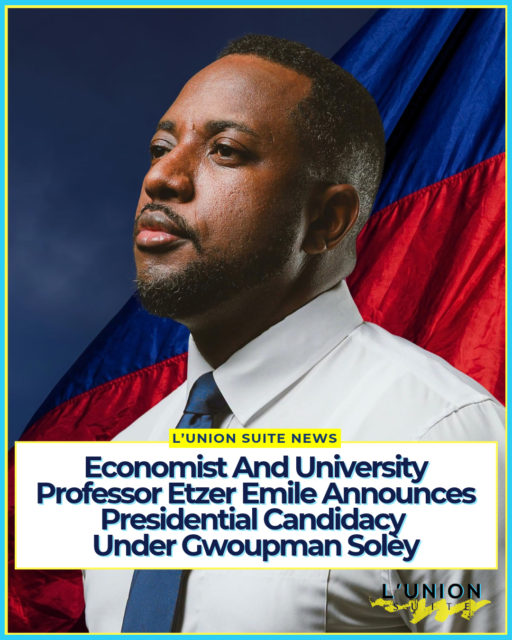
Economist, university professor, and entrepreneur Etzer Emile formally announced on Saturday, October 31, his candidacy for the presidency of Haiti under the banner of the political grouping Gwoupman Solèy (also referred to as SOLEY). The announcement came via a video statement and a campaign communiqué.
Emile, who has long analyzed Haiti’s economic and institutional challenges through teaching, writing, and public commentary, frames his run around three core priorities: security, jobs, and social justice. In the statement, he said improving security is the essential precondition for restoring public confidence, economic activity, and access to basic services. “The problem is not the truck. It’s the driver model that needs to change,” he stated, arguing that the country needs a government capable of protecting citizens, stimulating wealth creation, and remaining accountable.
On security, Emile proposes strengthening the country’s security and justice institutions, improving intelligence capabilities, combating the illegal circulation of weapons, and tightening border controls, while respecting the law and human rights. He has said families should be able to live without fear and workers should be able to move freely.
For employment and economic recovery, he calls for infrastructure development and administrative and tax reforms aimed at attracting local and foreign investment across industry, agriculture, tourism, commerce, and renewable energy sources such as solar and wind. On governance and social justice, he pledges to end patronage-based hiring in public administration, publish state expenditures, combat corruption and impunity, ensure equal treatment of citizens, and protect women against violence and discrimination. He also emphasizes greater participation for Haitians in the provinces, the diaspora, and people with disabilities.
Born on September 1, 1985, in Cavaillon, Emile is 41. He is married and the father of two boys. He studied economics at Université Quisqueya (where he teaches) and sociology at the State University of Haiti, then earned an MBA in finance and banking in Taiwan.
#lunionsuite #haitianamerican
2 days ago


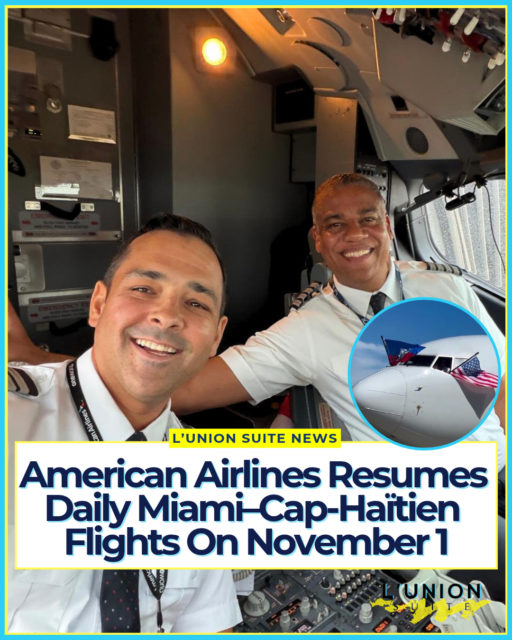
American Airlines officially returned to Haiti on Sunday, November 1, with the arrival of its first commercial flight at Cap-Haïtien’s Hugo Chávez International Airport. The move ends nearly two years of suspended operations by major U.S. carriers in the country.
Flight AA2492 departed Miami International Airport aboard a Boeing 737 aircraft and landed in Cap-Haïtien, marking the resumption of regular commercial service. The inaugural flight operated with an all-Haitian crew. Airport officials organized activities to mark the occasion at both ends of the route, with inaugural events planned in Miami and Cap-Haïtien.
The airline is now operating daily nonstop service between Miami and Cap-Haïtien using Boeing 737 aircraft. Typical schedules show morning departures from Miami around 10:15–10:20 a.m. arriving in Cap-Haïtien around 12:15–12:28 p.m., with the return flight departing Cap-Haïtien in the early afternoon and reaching Miami mid-afternoon.
The airline had announced the November 1 restart earlier in the year, becoming the first major U.S. carrier to formally restore regular commercial flights to Haiti since the late-2024 suspension.
U.S. commercial service to Haiti was largely halted in late 2024 after multiple incidents in which commercial aircraft were struck by gunfire near Port-au-Prince amid the country’s gang-related security crisis. The U.S. Federal Aviation Administration imposed restrictions barring U.S. carriers from the capital’s Toussaint Louverture International Airport; those restrictions on Port-au-Prince remain in effect. Cap-Haïtien and other northern airports were cleared for service, allowing this return.
American previously operated to Cap-Haïtien for years before broader suspensions. Haiti had been the only Caribbean nation without direct U.S. carrier flights during the suspension period. Regional operators continued limited Miami–Cap-Haïtien service in the interim.
#lunionsuite #haitianamerican #haitian
2 days ago


Fèt Gede, the Festival of the Dead, is one of the most sacred and powerful celebrations on the Haitian Vodou calendar. Held every year on November 1 and 2, All Saints’ Day and All Souls’ Day, it is a time when families and Vodouists gather in cemeteries across Haiti to honor the ancestors with offerings, rituals, drums, and the signature banda dance.
Also known as the Festival of the Ancestors, Fèt Gede (Fèt = Festival, Gede = the sacred dead) is far more than remembrance. It is a living conversation between the living and those who came before us. The Gede, the family of lwa who guard the threshold between life and death, are both fierce and joyful. They remind us that death is not an ending, but a continuation; that the ancestors still walk with us, guide us, and strengthen us. In their presence, the boundary thins, and the community reconnects with the roots that have sustained Haiti through every trial.
Often described as Haiti’s equivalent of Mardi Gras, Mexico’s Day of the Dead, and Halloween rolled into one, Fèt Gede carries its own deep truth: life and death, joy and sorrow, fertility and finality exist together. It is a celebration of resilience, of lineage, and of the unbreakable bond between the living and the dead.
📸 @verdyverna
#lunionsuite #haitianamerican #haitian
2 days ago

Haitians Honor Their Ancestors Through Fèt Gede, a Two-Day Celebration of Life, Death, and Tradition
Every year on November 1 and 2, Haitians in Haiti and across the diaspora observe Fèt Gede, one of the most meaningful celebrations in Haitian Vodou. It is a time to honor loved ones who have passed away, remember our ancestors, and celebrate the connection between the living and the dead.
During Fèt Gede, Vodou practitioners gather at cemeteries to pray, light candles, make offerings, and pay their respects. Some wear black, purple, and white, while others celebrate through music, dancing, and traditional ceremonies.
At the heart of the celebration are the Gede spirits, who are associated with death, ancestors, and the cycle of life. Baron Samedi and Manman Brigitte are among the best-known spirits connected to these traditions.
While Fèt Gede takes place around the same time as All Saints’ Day and All Souls’ Day, it has its own deep roots in Haitian history, spirituality, and culture.
For many Haitians, Fèt Gede is more than a day of remembrance. It is a celebration of those who came before us and the traditions that continue to connect generations.
#lunionsuite #haitianamerican
2 days ago


New York City Mayor Zohran Mamdani said Saturday that President Donald Trump has agreed to grant an immediate visa to the mother of 15-year-old Javits Frimpong after a phone call between the two.
“The murder of a child is a pain no parent should have to endure, let alone from thousands of miles away,” Mamdani posted on X. “Javits Frimpong’s mother deserves to say goodbye to her son in person. I just got off the phone with President Trump and he has agreed to grant her visa immediately. All of New York City is mourning this tragedy.”
Frimpong, a Ghanaian immigrant who had moved to the Bronx about a year earlier to live with his father, was fatally shot Thursday morning, October 29, while walking to school. Police said he was shot once in the abdomen near East 171st Street and Crotona Place in the Claremont section of the Bronx, shortly before 9:30 a.m. Officers transported him to St. Barnabas Hospital, where he was pronounced dead. No arrests have been made. Investigators are seeking three teenage males last seen in dark clothing and masks. The motive remains under investigation.
Frimpong’s father, Thomas Frimpong, has said his son had been bullied at DreamYard Preparatory School and that school officials had recently suspended two students in connection with incidents involving him.
Frimpong’s mother, Doris Adu Gyamfi, remains in Ghana (Kumasi). Ghana’s Foreign Minister Samuel Okudzeto Ablakwa said he had spoken with her and assigned officials to help with the visa process. He added that the Ghanaian government would cover her full travel costs and contribute toward a dignified funeral while continuing efforts to secure justice. Community members and elected officials have held vigils in the Bronx as the investigation continues.
#lunionsuite #haitianamerican
2 days ago


At Aya Nakamura’s sold-out concerts in Montreal’s on October 24–25, the French-Malian star performed an acoustic version of her song “J’ai mal.” As the guitar began, a familiar melody cut through the room. Many Haitian fans in the audience recognized it immediately. The opening notes closely matched “Se pa pou dat,” the long-running konpa classic by Haitian singer @AlanCave.
Nakamura continued with her lyrics without mentioning Cavé or the song. Within hours, videos of the moment circulated online. Some listeners saw the resemblance as an uncredited use of a major Haitian track. Others viewed it as a possible influence or a simple arrangement choice. The clips turned into a wider conversation about recognition, cultural borrowing, and how Haitian music sometimes appears on larger international stages without credit.
“Se pa pou dat” is one of the defining love songs of modern Haitian music. The track has remained a staple for more than two decades. Its slow, emotional melody is instantly recognizable to many in the Haitian diaspora, even to those who do not speak Kreyol. Aya Nakamura, is the most-streamed French-speaking female artist in the world. Her sound blends Afrobeat, R&B, & urban pop, and “J’ai mal” is an earlier, more vulnerable song that has stayed in her repertoire.
Days later, on October 30, Alan Cavé responded on Instagram. He had attended Nakamura’s shows and also joined a master class with her musicians. During that session, he learned that her drummer and musical director are Haitian, a discovery he described with pride. He later met Nakamura and thanked her and her team for their warm welcome.
Addressing the musical moment, he wrote:
“Hearing a few notes of ‘Se pa pou dat’ blend into your ‘J’ai mal’ in the middle of your show…it touched me, but I didn’t feel any pain. Next time, we could sing it together.” He added that it was beautiful to see a song he created years ago continue its journey into another generation’s music.
Rather than focusing on the debate, Cavé treated the moment as a sign that the song is still traveling and framed the unexpected connection as an open door.
🎥 @Naishaazorr Janellesimonee1/Tiktok
#lunionsuite
2 days ago
Burna Boy made history on October 29 as the first African artist to perform at Apple Music Hall, Apple’s new 600-capacity live music venue inside London’s iconic Battersea Power Station.
The intimate venue, which opened just weeks earlier, is designed to bring artists and audiences closer together, featuring advanced Spatial Audio technology.One of the night’s standout moments came during his performance of “4 Kampé II,” his collaboration with Haitian artist Joé Dwèt Filé. A large Haitian flag was displayed behind Burna Boy as he performed the track, with dancers and his full band bringing the song to life. The visual tribute and performance offered a moment of recognition for Haitian fans, who have embraced the collaboration.
The London performance came just four days after Burna Boy brought “4 Kampé II” to the international stage at the NFL Paris Game halftime show on October 25 at Stade de France. On that occasion, he invited Joé Dwèt Filé to join him, giving the two artists an opportunity to perform their collaboration together.
With “4 Kampé II” continuing to feature in Burna Boy’s live performances across international stages, the collaboration has become a notable part of his setlist. Rooted in Haitian konpa, the song represents a musical connection between two artists and continues to introduce Haitian sounds to audiences around the world.
#lunionsuite #haitianamerican #haitian
2 days ago