




Haiti

10 Things We Learned about Fete Gede “Haitian Day of The Dead”

Fete Gede
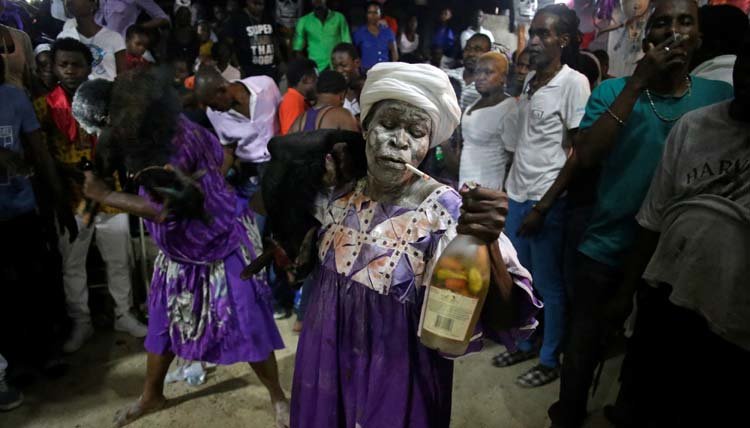
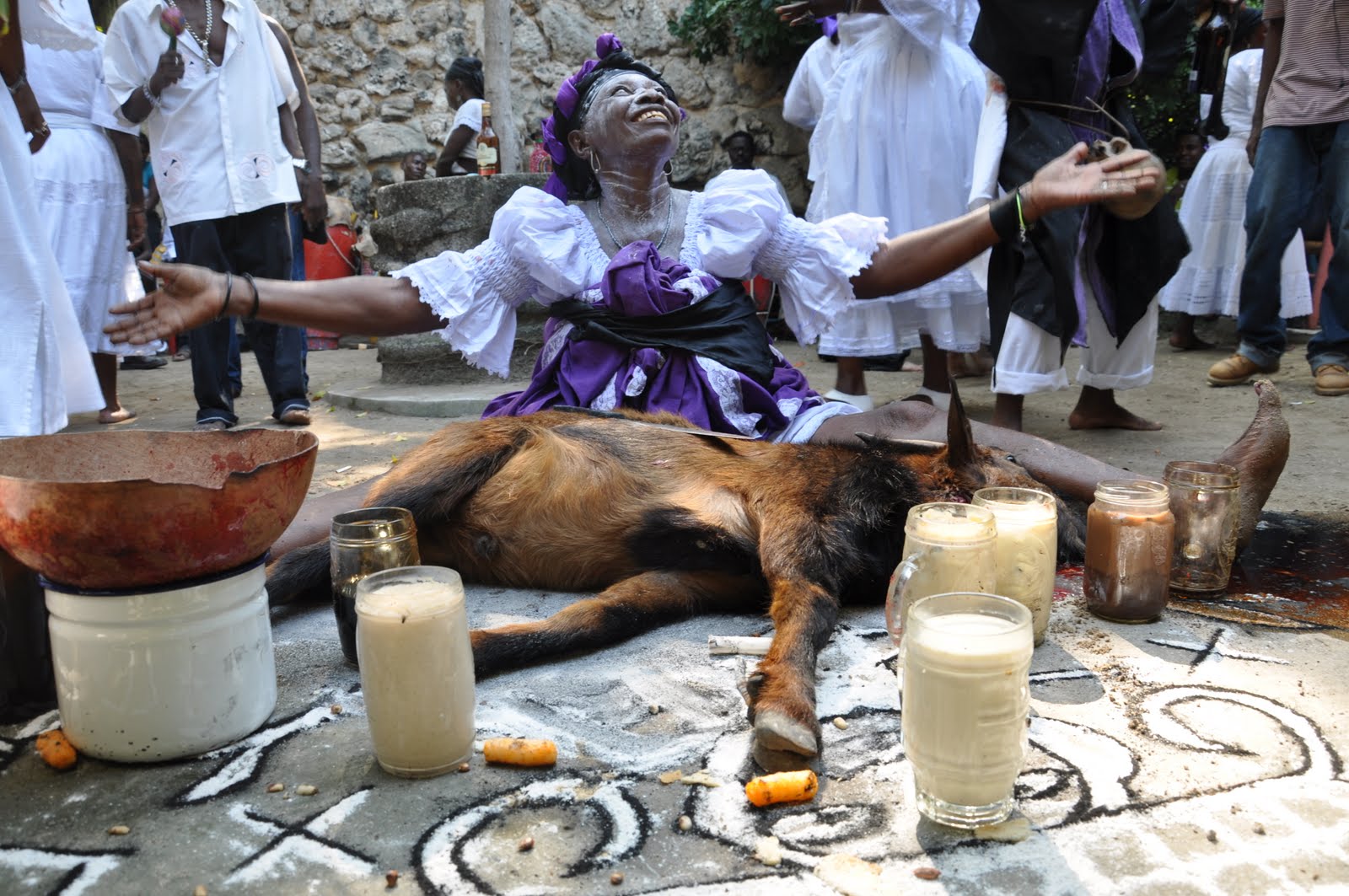
Voodoo believers carry dead goats during a ceremony of Fet Gede in a Peristil, a voodoo temple, in Port-au-Prince, Haiti, November 2, 2016. REUTERS/Andres Martinez Casares

Fête Gede, or “Festival of the Dead,” is one of the most important celebrations in the Voudou religious calendar. 

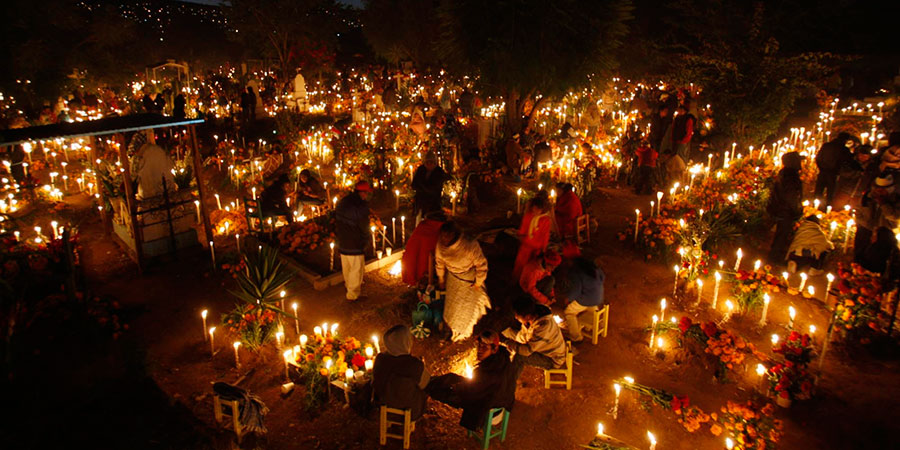
Fete Gede, the Feast of the Dead, is a time when Vodouisants celebrate the ancestral dead, typically held during either or both of the first two days in November. Known as the Festival of the Ancestors, Fet Gede (Fet = Festival, Gede = The Sacred Dead) is the Vodou equivalent of Mardi Gras, the Mexican Day of the Dead, and Halloween, all in one.

1. People dress up, take to the streets, dance their communion with the ancestors, and walk-in processions to the graveyards where they feed their ancestral dead with the gifts of their own table. In this way, spirits are honored and their protection is gained for the coming year.
Fete Gede
Fete Gede

2. In peristyles (churches) up and down the country, there is music, dancing, and feasting. The priests and the people come together, and there is enough drumming, singing, and laughter to – literally! – raise the dead. It is a time for celebration, for reconnecting with the past and preparing for the future, with music, processions, sacred rituals and spiritual observances taking place throughout.

3. Fete Gede is also a traditional vodou feast which celebrates the lwa (spirits) of death and fertility. Though it shares calendar space and ideology with the Roman Catholic Day of the Dead, or All Souls Day, Fête Gede can be more accurately said to derive from African traditions preserved largely unchanged through the centuries. 

4. Vodouists come in a spiritual pilgrimage to the cemetery to pay their respect to the dead, but first, permission of passage has to be obtained. The grave of Papa Gede, the first man who ever died. Ancestral services are held at this ‘crossroad’, considered to be the bridge between life and death. Kwa Baron is the Lwa guardian of the cemetery and head of the Gedes.

Fete Gede

5. Rituals take place throughout November but are most concentrated at the beginning of the month. Voodoo believers converge on the Haitian capital’s main cemetery to honor the Gede and the father of them all, Baron Samedi. They layout gifts such as homemade beeswax candles, flowers, food and, to warm the Gede’s bones, bottles of rum stuffed with chili peppers.

6. Fete Gede can be described as the Vodou equivalent of Mardi Gras, the Mexican Day of the Dead, and Halloween, all rolled into one incredible ritual with enough drumming, singing, alcohol, and laughter to quite literally raise the dead. The Fete Gede celebrations are unique to Haiti, a blend of traditions brought over from Africa during the slave trade, mixed with colonial Christianity and a dash of ritual from the original Taino inhabitants of the island.
Fete Gede
Fete Gede

7. Haitians believe that the frisky Vodou spirits helped them win independence and become the world’s first black republic. Tradition marks the beginning of the revolution at a vodou ceremony at Bois Caïman, where the call to arms was issued by a Houngan (Vodou priest), and within hours, the northern plantations were in flames. The rebellion spread through the entire colony and the rest is history as they say.

8. Who is Papa Gede?  The corpse of the ‘first man’ can in many ways be compared to the Tomb of the Unknown Soldier who is revered at memorials throughout the world – he may not necessarily be Haitian – just like the Baron is not Haitian nor African, he may be ‘other’ (foreign). Papa Gede is a psychopomp who waits at the crossroads to take departed souls into the afterlife, although he does not take a life before its time. Papa Gede has a very crude sense of humor, and a cunning ability to read people’s minds, knowing everything that happens in the worlds of the living and the dead.

9. In Haiti, the Guédé (also spelled Gede or Ghede, pronounced [ɡede] in Haitian Creole) is the family of Loa that embodies the powers of death and fertility. Guédé spirits include Ghede Doubye, Ghede Linto, Ghede Loraj, Guédé Nibo, and Guédé Ti Malis. All are known for the drum rhythm and dance called the “banda”. In possession, they will drink or rub themselves with a mixture of clairin (raw rum) and twenty-one habanero or goat peppers.
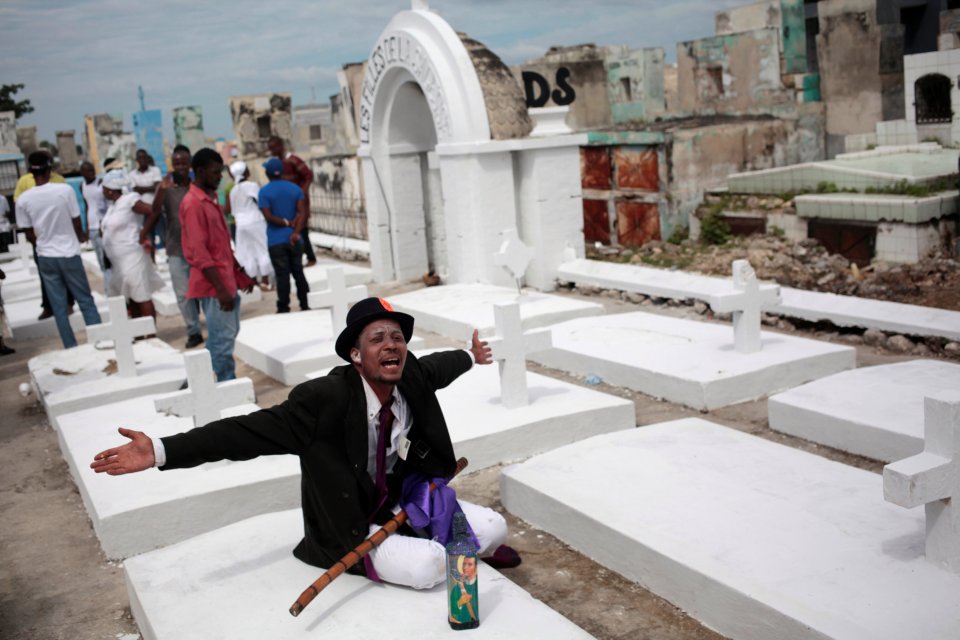
A man dressed as a “Gede”, or spirit of voodoo, greets people as they enter the cemetery – REUTERS

10. Vodou is a religion that can trace its roots back at least 6,000 years; some sources claim 10,000. It is freely practiced in West Africa and was in fact accepted as the state religion of Benin in 1996 where 80% of the population is followers. It is believed that over 60 million people practice vodou worldwide, 30 million of which are thought to be in West Africa. Vodou is widespread throughout the Caribbean, notably in Haiti where vodou was proclaimed the state religion in 2003 where is popularly stated that the people are 80% Catholics and 110% vodouists. It is also found in Brazil, the Guianas, Dominican Republic, and parts of the USA, introduced by the slaves.

This is just a quick informational guide about Fete Gede, please feel free to do your research if you are interested in learning more.

Check out these very informative sources and links below to learn more:

Source  Source  Source  Source  Source  Source
Facebook Comments

ADVERTISE WITH US

Categories

Featured In:


Instagram

@lunionsuite
#1 Haitian-American Platform®️

@lunionsuite

🇭🇹𝗖𝗼𝘂𝗻𝘁𝗿𝘆.𝗣𝗲𝗼𝗽𝗹𝗲.𝗖𝘂𝗹𝘁𝘂𝗿𝗲 👩🏽‍💻𝗘𝘀𝘁 2011 𝗯𝘆:@mrswanda ⌨️𝗙𝗕𝗼𝗼𝗸:#TheHaitianAmerican 𝗙𝗲𝗮𝘁:@forbes @bet @blackenterprise @nbcnews @nytimes @miamiherald +
  • Nigerian Afrobeats star @heisrema is bringing a touch of Haiti into his latest release.⁠
⁠
Rema dropped his new single “Oh No” on September 11, blending his Afropop sound with kompa, dancehall and reggaeton influences. The track was produced by Jamaican producer Rvssian and leans into guitar-driven Caribbean rhythms while keeping Rema’s melodic style at the center.⁠
⁠
For Haitians, the kompa influence stands out. The genre was developed in Haiti in the 1950s and has grown far beyond the country, influencing music throughout the Caribbean, Africa, Europe and the Haitian diaspora.⁠
⁠
The release is another example of how Haitian music continues to travel across borders and find its way into sounds from artists around the world.⁠
⁠
“Oh No” is now available on major streaming platforms, with a music video accompanying the release.⁠
⁠
#lunionsuite #haitianamerican
  • Florida health officials are warning residents to protect themselves from mosquitoes as locally acquired dengue cases continue to rise across the state, with the Tampa Bay area seeing the largest increase.⁠
⁠
Hillsborough County has become the center of the outbreak. According to the latest figures reported by the Florida Department of Health, the county reached 95 locally acquired dengue cases for the week ending September 5, compared with 59 the week before. Cases have also been reported in other parts of Florida, including Pinellas, Orange and Miami-Dade counties.⁠
⁠
“Locally acquired” means the person was infected by a mosquito in Florida rather than while traveling outside the country. Dengue is spread through the bite of an infected mosquito and can cause fever, severe muscle and joint pain, headaches and rash.⁠
⁠
Mosquito-control teams are responding with increased surveillance, inspections and targeted spraying. Orange County, for example, expanded mosquito treatments after confirming a locally acquired dengue case earlier this month.⁠
⁠
Health officials are asking residents to drain standing water around their homes, use mosquito repellent and cover exposed skin when possible.⁠
⁠
#lunionsuite #haitianamerican
  • Florida’s Board of Governors voted unanimously to bar students who are not lawfully present in the United States from enrolling in the state’s 12 public universities beginning with the 2027-28 academic year.⁠
⁠
The regulation, approved without debate after earlier preliminary approval in June, applies to any university that did not admit all academically qualified applicants in the two most recent academic years. Because all 12 State University System campuses operate selective admissions, the rule effectively closes those institutions to new undocumented students. Currently enrolled students are not affected.⁠
⁠
The university ban follows a June vote by the Florida Board of Education that already prohibited undocumented students from the state’s 28 public colleges and most adult education and GED programs. Together, the two policies shut undocumented students out of public higher education in Florida. The state now joins Alabama, Georgia, and South Carolina in imposing such restrictions.⁠
⁠
Legislative bills that would have achieved a similar result died in committee during the 2026 session. The boards then used their rulemaking authority to adopt the limits. Lt. Gov. Jay Collins called the university rule “common sense,” saying public universities are for students who are here legally and that taxpayers should not subsidize those who “broke our laws to come here.”⁠
⁠
Critics, including United Faculty of Florida president Robert Cassanello, described the move as overreach that closes educational doors and limits the system’s ability to educate future workers. Exact current enrollment figures for undocumented students are not published, but earlier counts of out-of-state tuition waiver users put the number at roughly 2,000 at universities and more than 4,600 at state colleges in 2024-25. Broader estimates of undocumented students in Florida higher education have been far higher.⁠
⁠
Private universities are not covered by the rule. Online students studying from outside the United States also remain eligible. The policy takes effect for new enrollments in fall 2027.⁠
⁠
Video Source: @Wfla⁠
#lunionsuite #haitianamerican #haitian
  • Twenty-five years have passed, but September 11 remains a day America will never forget.⁠
⁠
On this day in 2001, 19 al-Qaeda terrorists hijacked four commercial airplanes. Two were flown into the World Trade Center towers in New York City, another struck the Pentagon in Virginia, and the fourth, United Airlines Flight 93, crashed in Pennsylvania after passengers and crew fought back. A total of 2,977 people were killed.⁠
⁠
Today, families, survivors, first responders and communities across the country are marking the 25th anniversary of 9/11 with moments of silence, memorial ceremonies, readings of victims’ names and acts of service. At Ground Zero in New York, relatives gathered once again to honor the people they lost. Commemorations are also taking place at the Pentagon and the Flight 93 site in Pennsylvania.⁠
⁠
This year's anniversary also recognizes a painful part of the tragedy that continued long after that morning. The New York ceremony added a moment of silence for people who later died from illnesses linked to exposure to toxic dust following the collapse of the Twin Towers.⁠
⁠
For a generation that was not yet born or was too young to remember September 11, the anniversary is also a reminder of why these stories continue to be told.⁠
⁠
Twenty-five years later, we remember the lives lost, the families who still carry that loss and the first responders who ran toward danger to help others. We will never forget.⁠
⁠
#lunionsuite #haitianamerican
  • An ICE Air deportation flight landed in Cap-Haïtien after sunset on Thursday, returning 82 Haitian nationals. Among those on board, Haitian officials said, were two young boys: a 3-year-old U.S. citizen and a 6-year-old born in Brazil, both traveling with Haitian parents.⁠
⁠
The plane, which originated in Alexandria, Louisiana, and made a stop at Opa-locka Executive Airport in South Florida, was hours behind schedule. Haitian authorities had prepared for a daytime arrival. Instead, the aircraft touched down after dark, long after government offices had closed and after deportees had already spent more than 13 hours in shackles, not counting flight time.⁠
⁠
Office National de la Migration (ONM) staff who had been mobilized since morning stayed at the airport well into the night. Workers did not leave until after 2 a.m., according to accounts from the ground, because the late landing compressed screening, police checks, basic assistance, and transport into the early hours.⁠
⁠
ONM Director General Jean Négot Bonheur Delva has previously said Haiti’s working hours for receiving returnees run from 8 a.m. to 4 p.m., and that the latest practical window for an aircraft is early afternoon because processing alone takes two to three hours. A sunset arrival, he has warned, forces overtime, extra security, and staff who traveled from Port-au-Prince to miss return flights.⁠
⁠
Thursday’s flight is part of a weekly cadence of removals that began after the Trump administration terminated Temporary Protected Status for Haitians and the U.S. Supreme Court allowed that decision to take effect. Flights that once arrived roughly once a month now land in Cap-Haïtien almost every Thursday, because Port-au-Prince’s international airport remains too dangerous for U.S. aircraft.⁠
⁠
Returnees typically receive a small stipend from the Haitian government, far less than the cost of a ticket or a safe overland trip toward Port-au-Prince. Many have no family in the north. The highway south remains under gang control. Some stay stranded in Cap-Haïtien with little more than the clothes issued in U.S. detention.⁠
⁠
#lunionsuite #haitianamerican #haitian
  • Tyler Perry’s long-awaited third chapter in the Why Did I Get Married? franchise is here. Why Did I Get Married Again? landed on Netflix on September 9, sending the original friend group to a lavish destination wedding on Italy’s Lake Como, and handing the next generation the keys to the same messy, familiar relationship questions their parents asked nearly two decades ago.⁠
⁠
The story centers on Jasmine (Armani Greer), daughter of Marcus (Michael Jai White) and Angela (Tasha Smith), as she prepares to marry Wesley (Everett Osborne). The older couples  including Tyler Perry as Terry, Sharon Leal as Dianne, Jill Scott as Sheila, Lamman Rucker as Troy, and Richard T. Jones as Mike  reunite and quickly discover their grown children have inherited more than just their last names. Taraji P. Henson joins the series as Roselyn, Wesley’s mother. Janet Jackson’s Patricia is acknowledged but does not appear.⁠
⁠
Among the new faces, Haitian-American actor Da’Vinchi plays Marcus Jr.  Jasmine’s brother, Wesley’s best friend, and a character whose history with Regina (Sydney Winbush) adds extra heat to the wedding weekend. The role puts @Davinchi opposite Michael Jai White as his on-screen father.⁠
⁠
The cast marked the release with a special Los Angeles screening on September 8 at Harmony Gold Preview House. Perry, Henson, White, Smith, Leal, Rucker, Jones, Greer, Osborne, Laya DeLeon Hayes, Jaden Michael, Derrick A. King, Sydney Winbush, and Da’Vinchi walked the carpet together first time many of the younger players had been seen as a group off-screen. Da’Vinchi kept it clean and understated in neutrals: brown slacks and a button-up. ⁠
⁠
#lunionsuite #haitianamerican #haitian
  • Why Haitian parents are so intrusive?? 😂⁠
Papa Junior checking @rankontre in the dark 😂⁠
⁠
#lunionsuite #haitianamerican #ads
  • Naomi Osaka does not need anyone to like her clothes.
After her US Open run ended in a straight-sets loss to Elena Rybakina, a familiar wave of comments arrived: the outfits were too much, the walk-ons were a fashion show, she should just play tennis. Osaka answered the way she usually does, plainly, on her own platform, and without apology.
“You know… idgaf if you don’t like me,” she wrote. “I don’t mind being the first to do something and getting trashed for it. This happened when I talked about mental health and for some reason it’s happening with my clothes lol. I’m literally Haitian it’s in my blood to be this way, as long as the people after me have an easier path it’s worth it.”
Osaka, whose father Leonard François is from Jacmel, Haiti, and whose mother is Japanese, has spent 2026 treating Grand Slam walk-ons like a second language. At the Australian Open she arrived in a jellyfish-inspired look. At Roland Garros she layered gold sequins, trains, & jackets over her playing dress. At Wimbledon she walked out in a white kimono nodding to Kill Bill, then later wore a Haiti national team jersey after the country returned to the World Cup. In New York she paid tribute to Allen Iverson,  hooded robe, newspaper clippings from her own career, cornrows, headband, then played in black basketball-style kit.
The comparison to 2021 is not throwaway. When she skipped press at the French Open and later withdrew, citing mental health, the reaction was swift and often cruel. She kept going. Years later the conversation around athletes and mental health is different because she and others refused to stay quiet. She is applying the same logic to what she wears.
Tennis still has an unspoken uniform, clean, traditional, not too loud. Osaka keeps breaking it in public. That bothers people who think the court should look a certain way. It also opens space for younger players who want to bring their whole self, culture, hair, history, humor, onto the biggest stages without waiting for permission.
She is not asking for everyone to get it. She does not do it for the people who will never understand. She does it for the ones who look like her.
#lunionsuite #haitianamerican
  • Soca king Machel Montano paused the party long enough to speak directly to Haitian fans.⁠
⁠
In a clip circulating from a recent live show, the Trinidad and Tobago star is onstage in a Statue of Liberty tank, mic in hand, working the crowd under purple lights. Then he switches gears. He calls out Haiti, talks about love, and works through Kreyol as the audience rides with him. ⁠
⁠
The moment fits how Montano has been talking about the region this year. In interviews around his documentary Like Ah Boss: Journey of a Soca King and the Encore tour, he has argued that soca’s next chapter is Caribbean unity Haiti and Cuba included  because the music already shares a pulse. Onstage, that idea becomes simpler: greet the people in the room.⁠
⁠
Montano has spent four decades turning carnival stages into meeting places  from Madison Square Garden as a child opener to Road March records and packed U.S. dates. This clip is short. What travels is the gesture: Haiti named, Creole attempted, love said out loud, and the show kept moving.⁠
⁠
🎥 @RumAndMusic⁠
#lunionsuite #haitianamerican #haitian  #culture #caribbean
  • After a video of shackled deportees set to a Haitian song sparked fury across the community, Homeland Security’s official account is back, this time telling Haitian doctors and lawyers that $3,000 is “an entrepreneur’s dream.”⁠
⁠
They heard the community. They saw the reaction. Then they posted again.⁠
⁠
On Tuesday, the official Department of Homeland Security account addressed Haitian doctors, lawyers, scholars, and engineers by name and told them to “imagine what you could do with $3000 in Haiti.” It called the stipend “an entrepreneur’s dream,” linked the CBP Home self-deportation page, and quoted a New York Times headline about deportees arriving in Cap-Haïtien broke and stranded.⁠
⁠
That is not a policy explainer. That is a punchline built on other people’s ruin. Less than two weeks earlier, the same agency posted a video of Black men in shackles and waist chains being walked onto a deportation flight. The footage was set to a Haitian song. On-screen text read: “Temporary Meant Temporary. Leave Now.” Community leaders called it reprehensible and dehumanizing. Pastors said they could not sleep. Families recognized the message immediately: this is how we will treat you, and we will film it.⁠
⁠
Every time Haitians object, to the end of TPS, to weekly flights into a country the State Department still warns Americans not to visit, to children on those planes, to people landing with government sweatpants and almost no cash, the official account answers with another taunt. $2,600. Then $3,000. “Closing time.” “Leave now.” “Entrepreneur’s dream.” The more the community names the humiliation, the more the messaging leans into it.⁠
⁠
That is the pattern. Not a one-off post. A strategy.⁠
⁠
The Times reporting DHS chose to quote is not satire. Deportees have been arriving in Cap-Haïtien weekly. Some say valuables vanished in transit. Haitian authorities have been giving adults the equivalent of about $80. People who worked in hospitals, drove, taught, and paid taxes in the United States are marooned in a city many of them do not know, with no safe way home. DHS looked at that and wrote a joke about starting a business.⁠
⁠
#lunionsuite #haitianamerican
  • Miss World 2026 closed September 5 in Nha Trang, Vietnam, with the Dominican Republic’s Joheirry Mola taking the crown. 
Haiti left with something the scoreboard does not measure: a first from Jérémie, a purpose-driven project recognized on the world stage, and a month of representation that put Haitian women at the center of the conversation.
Marie Kemlyne Lestalie Félix, 25, is the first woman from Jérémie to hold the Miss World Haiti title. She did not advance into the official Top 40 on coronation night. What Miss World itself highlighted was her place among the six Beauty With a Purpose finalists for the Americas and Caribbean, alongside Belize, French Guiana, Guatemala, Paraguay, and Venezuela. Belize’s Faith Edgar won the continental BWAP title and used that fast-track into the Top 40. Félix’s work still stood in that regional final six.
Her project, Inspire-Toi d’Elles (“Inspire Yourself from Them”), founded in 2023, is built on a simple idea: Haitian women and girls need living examples, not slogans. Through monthly gatherings, mentoring conversations, writing workshops, and visibility for women already building careers and businesses, the initiative has brought more than 150 women and girls into the same room with mentors. The line she carried through the competition “Si elles l’ont fait, nous pouvons aussi” was the heart of her pitch. On the Head-to-Head stage in Vietnam she spoke plainly about being judged for her appearance, her skin, her origins, and limited resources, and about building the space she once needed as a girl from a communal section.
She used the month in Vietnam the way Miss World is meant to be used: fashion, culture, and community as one package. She walked the opening and Top Model events, including the Vietnam Beauty Fashion Fest, and carried Haitian identity into a competition that too often notices Haiti only when the headlines are about crisis.
A crown is one night. What she brought home is the work, the first for Jérémie, and a reminder that representation is already an accomplishment.
📸 @missworld @mariekemlynefelix
#lunionsuite #haitianamerican
  • Authorities in the Turks and Caicos Islands intercepted an overcrowded vessel carrying 207 migrants, including Haitian nationals, early Monday, September 7, as it attempted to reach the British overseas territory. Officials said the passengers were brought ashore safely and transferred to immigration authorities for processing.⁠
⁠
The operation followed another interception on September 2, when the Royal Turks and Caicos Islands Police Force stopped a vessel carrying 171 migrants near Northwest Point, Providenciales. Police said coastal radar detected the boat before it could make landfall. Marine Branch officers escorted the passengers to South Dock and handed them over to the Turks and Caicos Islands Border Force.⁠
⁠
A third vessel was stopped near the Bahamas on September 3. The Royal Bahamas Defence Force reported finding 146 Haitian migrants  111 men, 30 women, two boys and three girls  aboard a 45-foot boat about 17 miles northeast of Great Inagua. The passengers were taken to Matthew Town for processing. Together, the three operations account for 524 migrants intercepted in the region since September 2.⁠
⁠
Turks and Caicos police had already reported approximately 1,075 migrants intercepted aboard eight vessels in 2026 before Monday’s operation. Authorities have not yet released a detailed breakdown of the 207 passengers or announced their next steps.⁠
⁠
The latest intercepts come as Haitians continue attempting dangerous maritime crossings amid insecurity, economic hardship and limited opportunities at home. Regional forces have repeatedly warned that overloaded boats remain a serious risk to life at sea, even as they report that recent groups were brought ashore without reported casualties.⁠
⁠
#lunionsuite #haitianamerican #haitian
Nigerian Afrobeats star @heisrema is bringing a touch of Haiti into his latest release.⁠ ⁠ Rema dropped his new single “Oh No” on September 11, blending his Afropop sound with kompa, dancehall and reggaeton influences. The track was produced by Jamaican producer Rvssian and leans into guitar-driven Caribbean rhythms while keeping Rema’s melodic style at the center.⁠ ⁠ For Haitians, the kompa influence stands out. The genre was developed in Haiti in the 1950s and has grown far beyond the country, influencing music throughout the Caribbean, Africa, Europe and the Haitian diaspora.⁠ ⁠ The release is another example of how Haitian music continues to travel across borders and find its way into sounds from artists around the world.⁠ ⁠ “Oh No” is now available on major streaming platforms, with a music video accompanying the release.⁠ ⁠ #lunionsuite #haitianamerican
33 minutes ago
View on Instagram |
1/12
Florida health officials are warning residents to protect themselves from mosquitoes as locally acquired dengue cases continue to rise across the state, with the Tampa Bay area seeing the largest increase.⁠
⁠
Hillsborough County has become the center of the outbreak. According to the latest figures reported by the Florida Department of Health, the county reached 95 locally acquired dengue cases for the week ending September 5, compared with 59 the week before. Cases have also been reported in other parts of Florida, including Pinellas, Orange and Miami-Dade counties.⁠
⁠
“Locally acquired” means the person was infected by a mosquito in Florida rather than while traveling outside the country. Dengue is spread through the bite of an infected mosquito and can cause fever, severe muscle and joint pain, headaches and rash.⁠
⁠
Mosquito-control teams are responding with increased surveillance, inspections and targeted spraying. Orange County, for example, expanded mosquito treatments after confirming a locally acquired dengue case earlier this month.⁠
⁠
Health officials are asking residents to drain standing water around their homes, use mosquito repellent and cover exposed skin when possible.⁠
⁠
#lunionsuite #haitianamerican
Florida health officials are warning residents to protect themselves from mosquitoes as locally acquired dengue cases continue to rise across the state, with the Tampa Bay area seeing the largest increase.⁠ ⁠ Hillsborough County has become the center of the outbreak. According to the latest figures reported by the Florida Department of Health, the county reached 95 locally acquired dengue cases for the week ending September 5, compared with 59 the week before. Cases have also been reported in other parts of Florida, including Pinellas, Orange and Miami-Dade counties.⁠ ⁠ “Locally acquired” means the person was infected by a mosquito in Florida rather than while traveling outside the country. Dengue is spread through the bite of an infected mosquito and can cause fever, severe muscle and joint pain, headaches and rash.⁠ ⁠ Mosquito-control teams are responding with increased surveillance, inspections and targeted spraying. Orange County, for example, expanded mosquito treatments after confirming a locally acquired dengue case earlier this month.⁠ ⁠ Health officials are asking residents to drain standing water around their homes, use mosquito repellent and cover exposed skin when possible.⁠ ⁠ #lunionsuite #haitianamerican
2 hours ago
View on Instagram |
2/12
Florida’s Board of Governors voted unanimously to bar students who are not lawfully present in the United States from enrolling in the state’s 12 public universities beginning with the 2027-28 academic year.⁠ ⁠ The regulation, approved without debate after earlier preliminary approval in June, applies to any university that did not admit all academically qualified applicants in the two most recent academic years. Because all 12 State University System campuses operate selective admissions, the rule effectively closes those institutions to new undocumented students. Currently enrolled students are not affected.⁠ ⁠ The university ban follows a June vote by the Florida Board of Education that already prohibited undocumented students from the state’s 28 public colleges and most adult education and GED programs. Together, the two policies shut undocumented students out of public higher education in Florida. The state now joins Alabama, Georgia, and South Carolina in imposing such restrictions.⁠ ⁠ Legislative bills that would have achieved a similar result died in committee during the 2026 session. The boards then used their rulemaking authority to adopt the limits. Lt. Gov. Jay Collins called the university rule “common sense,” saying public universities are for students who are here legally and that taxpayers should not subsidize those who “broke our laws to come here.”⁠ ⁠ Critics, including United Faculty of Florida president Robert Cassanello, described the move as overreach that closes educational doors and limits the system’s ability to educate future workers. Exact current enrollment figures for undocumented students are not published, but earlier counts of out-of-state tuition waiver users put the number at roughly 2,000 at universities and more than 4,600 at state colleges in 2024-25. Broader estimates of undocumented students in Florida higher education have been far higher.⁠ ⁠ Private universities are not covered by the rule. Online students studying from outside the United States also remain eligible. The policy takes effect for new enrollments in fall 2027.⁠ ⁠ Video Source: @Wfla⁠ #lunionsuite #haitianamerican #haitian
1 day ago
View on Instagram |
3/12
Twenty-five years have passed, but September 11 remains a day America will never forget.⁠
⁠
On this day in 2001, 19 al-Qaeda terrorists hijacked four commercial airplanes. Two were flown into the World Trade Center towers in New York City, another struck the Pentagon in Virginia, and the fourth, United Airlines Flight 93, crashed in Pennsylvania after passengers and crew fought back. A total of 2,977 people were killed.⁠
⁠
Today, families, survivors, first responders and communities across the country are marking the 25th anniversary of 9/11 with moments of silence, memorial ceremonies, readings of victims’ names and acts of service. At Ground Zero in New York, relatives gathered once again to honor the people they lost. Commemorations are also taking place at the Pentagon and the Flight 93 site in Pennsylvania.⁠
⁠
This year's anniversary also recognizes a painful part of the tragedy that continued long after that morning. The New York ceremony added a moment of silence for people who later died from illnesses linked to exposure to toxic dust following the collapse of the Twin Towers.⁠
⁠
For a generation that was not yet born or was too young to remember September 11, the anniversary is also a reminder of why these stories continue to be told.⁠
⁠
Twenty-five years later, we remember the lives lost, the families who still carry that loss and the first responders who ran toward danger to help others. We will never forget.⁠
⁠
#lunionsuite #haitianamerican
Twenty-five years have passed, but September 11 remains a day America will never forget.⁠ ⁠ On this day in 2001, 19 al-Qaeda terrorists hijacked four commercial airplanes. Two were flown into the World Trade Center towers in New York City, another struck the Pentagon in Virginia, and the fourth, United Airlines Flight 93, crashed in Pennsylvania after passengers and crew fought back. A total of 2,977 people were killed.⁠ ⁠ Today, families, survivors, first responders and communities across the country are marking the 25th anniversary of 9/11 with moments of silence, memorial ceremonies, readings of victims’ names and acts of service. At Ground Zero in New York, relatives gathered once again to honor the people they lost. Commemorations are also taking place at the Pentagon and the Flight 93 site in Pennsylvania.⁠ ⁠ This year's anniversary also recognizes a painful part of the tragedy that continued long after that morning. The New York ceremony added a moment of silence for people who later died from illnesses linked to exposure to toxic dust following the collapse of the Twin Towers.⁠ ⁠ For a generation that was not yet born or was too young to remember September 11, the anniversary is also a reminder of why these stories continue to be told.⁠ ⁠ Twenty-five years later, we remember the lives lost, the families who still carry that loss and the first responders who ran toward danger to help others. We will never forget.⁠ ⁠ #lunionsuite #haitianamerican
1 day ago
View on Instagram |
4/12
An ICE Air deportation flight landed in Cap-Haïtien after sunset on Thursday, returning 82 Haitian nationals. Among those on board, Haitian officials said, were two young boys: a 3-year-old U.S. citizen and a 6-year-old born in Brazil, both traveling with Haitian parents.⁠
⁠
The plane, which originated in Alexandria, Louisiana, and made a stop at Opa-locka Executive Airport in South Florida, was hours behind schedule. Haitian authorities had prepared for a daytime arrival. Instead, the aircraft touched down after dark, long after government offices had closed and after deportees had already spent more than 13 hours in shackles, not counting flight time.⁠
⁠
Office National de la Migration (ONM) staff who had been mobilized since morning stayed at the airport well into the night. Workers did not leave until after 2 a.m., according to accounts from the ground, because the late landing compressed screening, police checks, basic assistance, and transport into the early hours.⁠
⁠
ONM Director General Jean Négot Bonheur Delva has previously said Haiti’s working hours for receiving returnees run from 8 a.m. to 4 p.m., and that the latest practical window for an aircraft is early afternoon because processing alone takes two to three hours. A sunset arrival, he has warned, forces overtime, extra security, and staff who traveled from Port-au-Prince to miss return flights.⁠
⁠
Thursday’s flight is part of a weekly cadence of removals that began after the Trump administration terminated Temporary Protected Status for Haitians and the U.S. Supreme Court allowed that decision to take effect. Flights that once arrived roughly once a month now land in Cap-Haïtien almost every Thursday, because Port-au-Prince’s international airport remains too dangerous for U.S. aircraft.⁠
⁠
Returnees typically receive a small stipend from the Haitian government, far less than the cost of a ticket or a safe overland trip toward Port-au-Prince. Many have no family in the north. The highway south remains under gang control. Some stay stranded in Cap-Haïtien with little more than the clothes issued in U.S. detention.⁠
⁠
#lunionsuite #haitianamerican #haitian
An ICE Air deportation flight landed in Cap-Haïtien after sunset on Thursday, returning 82 Haitian nationals. Among those on board, Haitian officials said, were two young boys: a 3-year-old U.S. citizen and a 6-year-old born in Brazil, both traveling with Haitian parents.⁠ ⁠ The plane, which originated in Alexandria, Louisiana, and made a stop at Opa-locka Executive Airport in South Florida, was hours behind schedule. Haitian authorities had prepared for a daytime arrival. Instead, the aircraft touched down after dark, long after government offices had closed and after deportees had already spent more than 13 hours in shackles, not counting flight time.⁠ ⁠ Office National de la Migration (ONM) staff who had been mobilized since morning stayed at the airport well into the night. Workers did not leave until after 2 a.m., according to accounts from the ground, because the late landing compressed screening, police checks, basic assistance, and transport into the early hours.⁠ ⁠ ONM Director General Jean Négot Bonheur Delva has previously said Haiti’s working hours for receiving returnees run from 8 a.m. to 4 p.m., and that the latest practical window for an aircraft is early afternoon because processing alone takes two to three hours. A sunset arrival, he has warned, forces overtime, extra security, and staff who traveled from Port-au-Prince to miss return flights.⁠ ⁠ Thursday’s flight is part of a weekly cadence of removals that began after the Trump administration terminated Temporary Protected Status for Haitians and the U.S. Supreme Court allowed that decision to take effect. Flights that once arrived roughly once a month now land in Cap-Haïtien almost every Thursday, because Port-au-Prince’s international airport remains too dangerous for U.S. aircraft.⁠ ⁠ Returnees typically receive a small stipend from the Haitian government, far less than the cost of a ticket or a safe overland trip toward Port-au-Prince. Many have no family in the north. The highway south remains under gang control. Some stay stranded in Cap-Haïtien with little more than the clothes issued in U.S. detention.⁠ ⁠ #lunionsuite #haitianamerican #haitian
1 day ago
View on Instagram |
5/12
Tyler Perry’s long-awaited third chapter in the Why Did I Get Married? franchise is here. Why Did I Get Married Again? landed on Netflix on September 9, sending the original friend group to a lavish destination wedding on Italy’s Lake Como, and handing the next generation the keys to the same messy, familiar relationship questions their parents asked nearly two decades ago.⁠
⁠
The story centers on Jasmine (Armani Greer), daughter of Marcus (Michael Jai White) and Angela (Tasha Smith), as she prepares to marry Wesley (Everett Osborne). The older couples  including Tyler Perry as Terry, Sharon Leal as Dianne, Jill Scott as Sheila, Lamman Rucker as Troy, and Richard T. Jones as Mike  reunite and quickly discover their grown children have inherited more than just their last names. Taraji P. Henson joins the series as Roselyn, Wesley’s mother. Janet Jackson’s Patricia is acknowledged but does not appear.⁠
⁠
Among the new faces, Haitian-American actor Da’Vinchi plays Marcus Jr.  Jasmine’s brother, Wesley’s best friend, and a character whose history with Regina (Sydney Winbush) adds extra heat to the wedding weekend. The role puts @Davinchi opposite Michael Jai White as his on-screen father.⁠
⁠
The cast marked the release with a special Los Angeles screening on September 8 at Harmony Gold Preview House. Perry, Henson, White, Smith, Leal, Rucker, Jones, Greer, Osborne, Laya DeLeon Hayes, Jaden Michael, Derrick A. King, Sydney Winbush, and Da’Vinchi walked the carpet together first time many of the younger players had been seen as a group off-screen. Da’Vinchi kept it clean and understated in neutrals: brown slacks and a button-up. ⁠
⁠
#lunionsuite #haitianamerican #haitian
Tyler Perry’s long-awaited third chapter in the Why Did I Get Married? franchise is here. Why Did I Get Married Again? landed on Netflix on September 9, sending the original friend group to a lavish destination wedding on Italy’s Lake Como, and handing the next generation the keys to the same messy, familiar relationship questions their parents asked nearly two decades ago.⁠
⁠
The story centers on Jasmine (Armani Greer), daughter of Marcus (Michael Jai White) and Angela (Tasha Smith), as she prepares to marry Wesley (Everett Osborne). The older couples  including Tyler Perry as Terry, Sharon Leal as Dianne, Jill Scott as Sheila, Lamman Rucker as Troy, and Richard T. Jones as Mike  reunite and quickly discover their grown children have inherited more than just their last names. Taraji P. Henson joins the series as Roselyn, Wesley’s mother. Janet Jackson’s Patricia is acknowledged but does not appear.⁠
⁠
Among the new faces, Haitian-American actor Da’Vinchi plays Marcus Jr.  Jasmine’s brother, Wesley’s best friend, and a character whose history with Regina (Sydney Winbush) adds extra heat to the wedding weekend. The role puts @Davinchi opposite Michael Jai White as his on-screen father.⁠
⁠
The cast marked the release with a special Los Angeles screening on September 8 at Harmony Gold Preview House. Perry, Henson, White, Smith, Leal, Rucker, Jones, Greer, Osborne, Laya DeLeon Hayes, Jaden Michael, Derrick A. King, Sydney Winbush, and Da’Vinchi walked the carpet together first time many of the younger players had been seen as a group off-screen. Da’Vinchi kept it clean and understated in neutrals: brown slacks and a button-up. ⁠
⁠
#lunionsuite #haitianamerican #haitian
Tyler Perry’s long-awaited third chapter in the Why Did I Get Married? franchise is here. Why Did I Get Married Again? landed on Netflix on September 9, sending the original friend group to a lavish destination wedding on Italy’s Lake Como, and handing the next generation the keys to the same messy, familiar relationship questions their parents asked nearly two decades ago.⁠
⁠
The story centers on Jasmine (Armani Greer), daughter of Marcus (Michael Jai White) and Angela (Tasha Smith), as she prepares to marry Wesley (Everett Osborne). The older couples  including Tyler Perry as Terry, Sharon Leal as Dianne, Jill Scott as Sheila, Lamman Rucker as Troy, and Richard T. Jones as Mike  reunite and quickly discover their grown children have inherited more than just their last names. Taraji P. Henson joins the series as Roselyn, Wesley’s mother. Janet Jackson’s Patricia is acknowledged but does not appear.⁠
⁠
Among the new faces, Haitian-American actor Da’Vinchi plays Marcus Jr.  Jasmine’s brother, Wesley’s best friend, and a character whose history with Regina (Sydney Winbush) adds extra heat to the wedding weekend. The role puts @Davinchi opposite Michael Jai White as his on-screen father.⁠
⁠
The cast marked the release with a special Los Angeles screening on September 8 at Harmony Gold Preview House. Perry, Henson, White, Smith, Leal, Rucker, Jones, Greer, Osborne, Laya DeLeon Hayes, Jaden Michael, Derrick A. King, Sydney Winbush, and Da’Vinchi walked the carpet together first time many of the younger players had been seen as a group off-screen. Da’Vinchi kept it clean and understated in neutrals: brown slacks and a button-up. ⁠
⁠
#lunionsuite #haitianamerican #haitian
Tyler Perry’s long-awaited third chapter in the Why Did I Get Married? franchise is here. Why Did I Get Married Again? landed on Netflix on September 9, sending the original friend group to a lavish destination wedding on Italy’s Lake Como, and handing the next generation the keys to the same messy, familiar relationship questions their parents asked nearly two decades ago.⁠
⁠
The story centers on Jasmine (Armani Greer), daughter of Marcus (Michael Jai White) and Angela (Tasha Smith), as she prepares to marry Wesley (Everett Osborne). The older couples  including Tyler Perry as Terry, Sharon Leal as Dianne, Jill Scott as Sheila, Lamman Rucker as Troy, and Richard T. Jones as Mike  reunite and quickly discover their grown children have inherited more than just their last names. Taraji P. Henson joins the series as Roselyn, Wesley’s mother. Janet Jackson’s Patricia is acknowledged but does not appear.⁠
⁠
Among the new faces, Haitian-American actor Da’Vinchi plays Marcus Jr.  Jasmine’s brother, Wesley’s best friend, and a character whose history with Regina (Sydney Winbush) adds extra heat to the wedding weekend. The role puts @Davinchi opposite Michael Jai White as his on-screen father.⁠
⁠
The cast marked the release with a special Los Angeles screening on September 8 at Harmony Gold Preview House. Perry, Henson, White, Smith, Leal, Rucker, Jones, Greer, Osborne, Laya DeLeon Hayes, Jaden Michael, Derrick A. King, Sydney Winbush, and Da’Vinchi walked the carpet together first time many of the younger players had been seen as a group off-screen. Da’Vinchi kept it clean and understated in neutrals: brown slacks and a button-up. ⁠
⁠
#lunionsuite #haitianamerican #haitian
Tyler Perry’s long-awaited third chapter in the Why Did I Get Married? franchise is here. Why Did I Get Married Again? landed on Netflix on September 9, sending the original friend group to a lavish destination wedding on Italy’s Lake Como, and handing the next generation the keys to the same messy, familiar relationship questions their parents asked nearly two decades ago.⁠
⁠
The story centers on Jasmine (Armani Greer), daughter of Marcus (Michael Jai White) and Angela (Tasha Smith), as she prepares to marry Wesley (Everett Osborne). The older couples  including Tyler Perry as Terry, Sharon Leal as Dianne, Jill Scott as Sheila, Lamman Rucker as Troy, and Richard T. Jones as Mike  reunite and quickly discover their grown children have inherited more than just their last names. Taraji P. Henson joins the series as Roselyn, Wesley’s mother. Janet Jackson’s Patricia is acknowledged but does not appear.⁠
⁠
Among the new faces, Haitian-American actor Da’Vinchi plays Marcus Jr.  Jasmine’s brother, Wesley’s best friend, and a character whose history with Regina (Sydney Winbush) adds extra heat to the wedding weekend. The role puts @Davinchi opposite Michael Jai White as his on-screen father.⁠
⁠
The cast marked the release with a special Los Angeles screening on September 8 at Harmony Gold Preview House. Perry, Henson, White, Smith, Leal, Rucker, Jones, Greer, Osborne, Laya DeLeon Hayes, Jaden Michael, Derrick A. King, Sydney Winbush, and Da’Vinchi walked the carpet together first time many of the younger players had been seen as a group off-screen. Da’Vinchi kept it clean and understated in neutrals: brown slacks and a button-up. ⁠
⁠
#lunionsuite #haitianamerican #haitian
Tyler Perry’s long-awaited third chapter in the Why Did I Get Married? franchise is here. Why Did I Get Married Again? landed on Netflix on September 9, sending the original friend group to a lavish destination wedding on Italy’s Lake Como, and handing the next generation the keys to the same messy, familiar relationship questions their parents asked nearly two decades ago.⁠
⁠
The story centers on Jasmine (Armani Greer), daughter of Marcus (Michael Jai White) and Angela (Tasha Smith), as she prepares to marry Wesley (Everett Osborne). The older couples  including Tyler Perry as Terry, Sharon Leal as Dianne, Jill Scott as Sheila, Lamman Rucker as Troy, and Richard T. Jones as Mike  reunite and quickly discover their grown children have inherited more than just their last names. Taraji P. Henson joins the series as Roselyn, Wesley’s mother. Janet Jackson’s Patricia is acknowledged but does not appear.⁠
⁠
Among the new faces, Haitian-American actor Da’Vinchi plays Marcus Jr.  Jasmine’s brother, Wesley’s best friend, and a character whose history with Regina (Sydney Winbush) adds extra heat to the wedding weekend. The role puts @Davinchi opposite Michael Jai White as his on-screen father.⁠
⁠
The cast marked the release with a special Los Angeles screening on September 8 at Harmony Gold Preview House. Perry, Henson, White, Smith, Leal, Rucker, Jones, Greer, Osborne, Laya DeLeon Hayes, Jaden Michael, Derrick A. King, Sydney Winbush, and Da’Vinchi walked the carpet together first time many of the younger players had been seen as a group off-screen. Da’Vinchi kept it clean and understated in neutrals: brown slacks and a button-up. ⁠
⁠
#lunionsuite #haitianamerican #haitian
Tyler Perry’s long-awaited third chapter in the Why Did I Get Married? franchise is here. Why Did I Get Married Again? landed on Netflix on September 9, sending the original friend group to a lavish destination wedding on Italy’s Lake Como, and handing the next generation the keys to the same messy, familiar relationship questions their parents asked nearly two decades ago.⁠
⁠
The story centers on Jasmine (Armani Greer), daughter of Marcus (Michael Jai White) and Angela (Tasha Smith), as she prepares to marry Wesley (Everett Osborne). The older couples  including Tyler Perry as Terry, Sharon Leal as Dianne, Jill Scott as Sheila, Lamman Rucker as Troy, and Richard T. Jones as Mike  reunite and quickly discover their grown children have inherited more than just their last names. Taraji P. Henson joins the series as Roselyn, Wesley’s mother. Janet Jackson’s Patricia is acknowledged but does not appear.⁠
⁠
Among the new faces, Haitian-American actor Da’Vinchi plays Marcus Jr.  Jasmine’s brother, Wesley’s best friend, and a character whose history with Regina (Sydney Winbush) adds extra heat to the wedding weekend. The role puts @Davinchi opposite Michael Jai White as his on-screen father.⁠
⁠
The cast marked the release with a special Los Angeles screening on September 8 at Harmony Gold Preview House. Perry, Henson, White, Smith, Leal, Rucker, Jones, Greer, Osborne, Laya DeLeon Hayes, Jaden Michael, Derrick A. King, Sydney Winbush, and Da’Vinchi walked the carpet together first time many of the younger players had been seen as a group off-screen. Da’Vinchi kept it clean and understated in neutrals: brown slacks and a button-up. ⁠
⁠
#lunionsuite #haitianamerican #haitian
Tyler Perry’s long-awaited third chapter in the Why Did I Get Married? franchise is here. Why Did I Get Married Again? landed on Netflix on September 9, sending the original friend group to a lavish destination wedding on Italy’s Lake Como, and handing the next generation the keys to the same messy, familiar relationship questions their parents asked nearly two decades ago.⁠
⁠
The story centers on Jasmine (Armani Greer), daughter of Marcus (Michael Jai White) and Angela (Tasha Smith), as she prepares to marry Wesley (Everett Osborne). The older couples  including Tyler Perry as Terry, Sharon Leal as Dianne, Jill Scott as Sheila, Lamman Rucker as Troy, and Richard T. Jones as Mike  reunite and quickly discover their grown children have inherited more than just their last names. Taraji P. Henson joins the series as Roselyn, Wesley’s mother. Janet Jackson’s Patricia is acknowledged but does not appear.⁠
⁠
Among the new faces, Haitian-American actor Da’Vinchi plays Marcus Jr.  Jasmine’s brother, Wesley’s best friend, and a character whose history with Regina (Sydney Winbush) adds extra heat to the wedding weekend. The role puts @Davinchi opposite Michael Jai White as his on-screen father.⁠
⁠
The cast marked the release with a special Los Angeles screening on September 8 at Harmony Gold Preview House. Perry, Henson, White, Smith, Leal, Rucker, Jones, Greer, Osborne, Laya DeLeon Hayes, Jaden Michael, Derrick A. King, Sydney Winbush, and Da’Vinchi walked the carpet together first time many of the younger players had been seen as a group off-screen. Da’Vinchi kept it clean and understated in neutrals: brown slacks and a button-up. ⁠
⁠
#lunionsuite #haitianamerican #haitian
Tyler Perry’s long-awaited third chapter in the Why Did I Get Married? franchise is here. Why Did I Get Married Again? landed on Netflix on September 9, sending the original friend group to a lavish destination wedding on Italy’s Lake Como, and handing the next generation the keys to the same messy, familiar relationship questions their parents asked nearly two decades ago.⁠
⁠
The story centers on Jasmine (Armani Greer), daughter of Marcus (Michael Jai White) and Angela (Tasha Smith), as she prepares to marry Wesley (Everett Osborne). The older couples  including Tyler Perry as Terry, Sharon Leal as Dianne, Jill Scott as Sheila, Lamman Rucker as Troy, and Richard T. Jones as Mike  reunite and quickly discover their grown children have inherited more than just their last names. Taraji P. Henson joins the series as Roselyn, Wesley’s mother. Janet Jackson’s Patricia is acknowledged but does not appear.⁠
⁠
Among the new faces, Haitian-American actor Da’Vinchi plays Marcus Jr.  Jasmine’s brother, Wesley’s best friend, and a character whose history with Regina (Sydney Winbush) adds extra heat to the wedding weekend. The role puts @Davinchi opposite Michael Jai White as his on-screen father.⁠
⁠
The cast marked the release with a special Los Angeles screening on September 8 at Harmony Gold Preview House. Perry, Henson, White, Smith, Leal, Rucker, Jones, Greer, Osborne, Laya DeLeon Hayes, Jaden Michael, Derrick A. King, Sydney Winbush, and Da’Vinchi walked the carpet together first time many of the younger players had been seen as a group off-screen. Da’Vinchi kept it clean and understated in neutrals: brown slacks and a button-up. ⁠
⁠
#lunionsuite #haitianamerican #haitian
Tyler Perry’s long-awaited third chapter in the Why Did I Get Married? franchise is here. Why Did I Get Married Again? landed on Netflix on September 9, sending the original friend group to a lavish destination wedding on Italy’s Lake Como, and handing the next generation the keys to the same messy, familiar relationship questions their parents asked nearly two decades ago.⁠
⁠
The story centers on Jasmine (Armani Greer), daughter of Marcus (Michael Jai White) and Angela (Tasha Smith), as she prepares to marry Wesley (Everett Osborne). The older couples  including Tyler Perry as Terry, Sharon Leal as Dianne, Jill Scott as Sheila, Lamman Rucker as Troy, and Richard T. Jones as Mike  reunite and quickly discover their grown children have inherited more than just their last names. Taraji P. Henson joins the series as Roselyn, Wesley’s mother. Janet Jackson’s Patricia is acknowledged but does not appear.⁠
⁠
Among the new faces, Haitian-American actor Da’Vinchi plays Marcus Jr.  Jasmine’s brother, Wesley’s best friend, and a character whose history with Regina (Sydney Winbush) adds extra heat to the wedding weekend. The role puts @Davinchi opposite Michael Jai White as his on-screen father.⁠
⁠
The cast marked the release with a special Los Angeles screening on September 8 at Harmony Gold Preview House. Perry, Henson, White, Smith, Leal, Rucker, Jones, Greer, Osborne, Laya DeLeon Hayes, Jaden Michael, Derrick A. King, Sydney Winbush, and Da’Vinchi walked the carpet together first time many of the younger players had been seen as a group off-screen. Da’Vinchi kept it clean and understated in neutrals: brown slacks and a button-up. ⁠
⁠
#lunionsuite #haitianamerican #haitian
Tyler Perry’s long-awaited third chapter in the Why Did I Get Married? franchise is here. Why Did I Get Married Again? landed on Netflix on September 9, sending the original friend group to a lavish destination wedding on Italy’s Lake Como, and handing the next generation the keys to the same messy, familiar relationship questions their parents asked nearly two decades ago.⁠ ⁠ The story centers on Jasmine (Armani Greer), daughter of Marcus (Michael Jai White) and Angela (Tasha Smith), as she prepares to marry Wesley (Everett Osborne). The older couples including Tyler Perry as Terry, Sharon Leal as Dianne, Jill Scott as Sheila, Lamman Rucker as Troy, and Richard T. Jones as Mike reunite and quickly discover their grown children have inherited more than just their last names. Taraji P. Henson joins the series as Roselyn, Wesley’s mother. Janet Jackson’s Patricia is acknowledged but does not appear.⁠ ⁠ Among the new faces, Haitian-American actor Da’Vinchi plays Marcus Jr. Jasmine’s brother, Wesley’s best friend, and a character whose history with Regina (Sydney Winbush) adds extra heat to the wedding weekend. The role puts @Davinchi opposite Michael Jai White as his on-screen father.⁠ ⁠ The cast marked the release with a special Los Angeles screening on September 8 at Harmony Gold Preview House. Perry, Henson, White, Smith, Leal, Rucker, Jones, Greer, Osborne, Laya DeLeon Hayes, Jaden Michael, Derrick A. King, Sydney Winbush, and Da’Vinchi walked the carpet together first time many of the younger players had been seen as a group off-screen. Da’Vinchi kept it clean and understated in neutrals: brown slacks and a button-up. ⁠ ⁠ #lunionsuite #haitianamerican #haitian
1 day ago
View on Instagram |
6/12
Why Haitian parents are so intrusive?? 😂⁠ Papa Junior checking @rankontre in the dark 😂⁠ ⁠ #lunionsuite #haitianamerican #ads
2 days ago
View on Instagram |
7/12
Naomi Osaka does not need anyone to like her clothes.
After her US Open run ended in a straight-sets loss to Elena Rybakina, a familiar wave of comments arrived: the outfits were too much, the walk-ons were a fashion show, she should just play tennis. Osaka answered the way she usually does, plainly, on her own platform, and without apology.
“You know… idgaf if you don’t like me,” she wrote. “I don’t mind being the first to do something and getting trashed for it. This happened when I talked about mental health and for some reason it’s happening with my clothes lol. I’m literally Haitian it’s in my blood to be this way, as long as the people after me have an easier path it’s worth it.”
Osaka, whose father Leonard François is from Jacmel, Haiti, and whose mother is Japanese, has spent 2026 treating Grand Slam walk-ons like a second language. At the Australian Open she arrived in a jellyfish-inspired look. At Roland Garros she layered gold sequins, trains, & jackets over her playing dress. At Wimbledon she walked out in a white kimono nodding to Kill Bill, then later wore a Haiti national team jersey after the country returned to the World Cup. In New York she paid tribute to Allen Iverson,  hooded robe, newspaper clippings from her own career, cornrows, headband, then played in black basketball-style kit.
The comparison to 2021 is not throwaway. When she skipped press at the French Open and later withdrew, citing mental health, the reaction was swift and often cruel. She kept going. Years later the conversation around athletes and mental health is different because she and others refused to stay quiet. She is applying the same logic to what she wears.
Tennis still has an unspoken uniform, clean, traditional, not too loud. Osaka keeps breaking it in public. That bothers people who think the court should look a certain way. It also opens space for younger players who want to bring their whole self, culture, hair, history, humor, onto the biggest stages without waiting for permission.
She is not asking for everyone to get it. She does not do it for the people who will never understand. She does it for the ones who look like her.
#lunionsuite #haitianamerican
Naomi Osaka does not need anyone to like her clothes.
After her US Open run ended in a straight-sets loss to Elena Rybakina, a familiar wave of comments arrived: the outfits were too much, the walk-ons were a fashion show, she should just play tennis. Osaka answered the way she usually does, plainly, on her own platform, and without apology.
“You know… idgaf if you don’t like me,” she wrote. “I don’t mind being the first to do something and getting trashed for it. This happened when I talked about mental health and for some reason it’s happening with my clothes lol. I’m literally Haitian it’s in my blood to be this way, as long as the people after me have an easier path it’s worth it.”
Osaka, whose father Leonard François is from Jacmel, Haiti, and whose mother is Japanese, has spent 2026 treating Grand Slam walk-ons like a second language. At the Australian Open she arrived in a jellyfish-inspired look. At Roland Garros she layered gold sequins, trains, & jackets over her playing dress. At Wimbledon she walked out in a white kimono nodding to Kill Bill, then later wore a Haiti national team jersey after the country returned to the World Cup. In New York she paid tribute to Allen Iverson,  hooded robe, newspaper clippings from her own career, cornrows, headband, then played in black basketball-style kit.
The comparison to 2021 is not throwaway. When she skipped press at the French Open and later withdrew, citing mental health, the reaction was swift and often cruel. She kept going. Years later the conversation around athletes and mental health is different because she and others refused to stay quiet. She is applying the same logic to what she wears.
Tennis still has an unspoken uniform, clean, traditional, not too loud. Osaka keeps breaking it in public. That bothers people who think the court should look a certain way. It also opens space for younger players who want to bring their whole self, culture, hair, history, humor, onto the biggest stages without waiting for permission.
She is not asking for everyone to get it. She does not do it for the people who will never understand. She does it for the ones who look like her.
#lunionsuite #haitianamerican
Naomi Osaka does not need anyone to like her clothes.
After her US Open run ended in a straight-sets loss to Elena Rybakina, a familiar wave of comments arrived: the outfits were too much, the walk-ons were a fashion show, she should just play tennis. Osaka answered the way she usually does, plainly, on her own platform, and without apology.
“You know… idgaf if you don’t like me,” she wrote. “I don’t mind being the first to do something and getting trashed for it. This happened when I talked about mental health and for some reason it’s happening with my clothes lol. I’m literally Haitian it’s in my blood to be this way, as long as the people after me have an easier path it’s worth it.”
Osaka, whose father Leonard François is from Jacmel, Haiti, and whose mother is Japanese, has spent 2026 treating Grand Slam walk-ons like a second language. At the Australian Open she arrived in a jellyfish-inspired look. At Roland Garros she layered gold sequins, trains, & jackets over her playing dress. At Wimbledon she walked out in a white kimono nodding to Kill Bill, then later wore a Haiti national team jersey after the country returned to the World Cup. In New York she paid tribute to Allen Iverson,  hooded robe, newspaper clippings from her own career, cornrows, headband, then played in black basketball-style kit.
The comparison to 2021 is not throwaway. When she skipped press at the French Open and later withdrew, citing mental health, the reaction was swift and often cruel. She kept going. Years later the conversation around athletes and mental health is different because she and others refused to stay quiet. She is applying the same logic to what she wears.
Tennis still has an unspoken uniform, clean, traditional, not too loud. Osaka keeps breaking it in public. That bothers people who think the court should look a certain way. It also opens space for younger players who want to bring their whole self, culture, hair, history, humor, onto the biggest stages without waiting for permission.
She is not asking for everyone to get it. She does not do it for the people who will never understand. She does it for the ones who look like her.
#lunionsuite #haitianamerican
Naomi Osaka does not need anyone to like her clothes. After her US Open run ended in a straight-sets loss to Elena Rybakina, a familiar wave of comments arrived: the outfits were too much, the walk-ons were a fashion show, she should just play tennis. Osaka answered the way she usually does, plainly, on her own platform, and without apology. “You know… idgaf if you don’t like me,” she wrote. “I don’t mind being the first to do something and getting trashed for it. This happened when I talked about mental health and for some reason it’s happening with my clothes lol. I’m literally Haitian it’s in my blood to be this way, as long as the people after me have an easier path it’s worth it.” Osaka, whose father Leonard François is from Jacmel, Haiti, and whose mother is Japanese, has spent 2026 treating Grand Slam walk-ons like a second language. At the Australian Open she arrived in a jellyfish-inspired look. At Roland Garros she layered gold sequins, trains, & jackets over her playing dress. At Wimbledon she walked out in a white kimono nodding to Kill Bill, then later wore a Haiti national team jersey after the country returned to the World Cup. In New York she paid tribute to Allen Iverson, hooded robe, newspaper clippings from her own career, cornrows, headband, then played in black basketball-style kit. The comparison to 2021 is not throwaway. When she skipped press at the French Open and later withdrew, citing mental health, the reaction was swift and often cruel. She kept going. Years later the conversation around athletes and mental health is different because she and others refused to stay quiet. She is applying the same logic to what she wears. Tennis still has an unspoken uniform, clean, traditional, not too loud. Osaka keeps breaking it in public. That bothers people who think the court should look a certain way. It also opens space for younger players who want to bring their whole self, culture, hair, history, humor, onto the biggest stages without waiting for permission. She is not asking for everyone to get it. She does not do it for the people who will never understand. She does it for the ones who look like her. #lunionsuite #haitianamerican
3 days ago
View on Instagram |
8/12
Soca king Machel Montano paused the party long enough to speak directly to Haitian fans.⁠ ⁠ In a clip circulating from a recent live show, the Trinidad and Tobago star is onstage in a Statue of Liberty tank, mic in hand, working the crowd under purple lights. Then he switches gears. He calls out Haiti, talks about love, and works through Kreyol as the audience rides with him. ⁠ ⁠ The moment fits how Montano has been talking about the region this year. In interviews around his documentary Like Ah Boss: Journey of a Soca King and the Encore tour, he has argued that soca’s next chapter is Caribbean unity Haiti and Cuba included because the music already shares a pulse. Onstage, that idea becomes simpler: greet the people in the room.⁠ ⁠ Montano has spent four decades turning carnival stages into meeting places from Madison Square Garden as a child opener to Road March records and packed U.S. dates. This clip is short. What travels is the gesture: Haiti named, Creole attempted, love said out loud, and the show kept moving.⁠ ⁠ 🎥 @RumAndMusic⁠ #lunionsuite #haitianamerican #haitian #culture #caribbean
3 days ago
View on Instagram |
9/12
After a video of shackled deportees set to a Haitian song sparked fury across the community, Homeland Security’s official account is back, this time telling Haitian doctors and lawyers that $3,000 is “an entrepreneur’s dream.”⁠
⁠
They heard the community. They saw the reaction. Then they posted again.⁠
⁠
On Tuesday, the official Department of Homeland Security account addressed Haitian doctors, lawyers, scholars, and engineers by name and told them to “imagine what you could do with $3000 in Haiti.” It called the stipend “an entrepreneur’s dream,” linked the CBP Home self-deportation page, and quoted a New York Times headline about deportees arriving in Cap-Haïtien broke and stranded.⁠
⁠
That is not a policy explainer. That is a punchline built on other people’s ruin. Less than two weeks earlier, the same agency posted a video of Black men in shackles and waist chains being walked onto a deportation flight. The footage was set to a Haitian song. On-screen text read: “Temporary Meant Temporary. Leave Now.” Community leaders called it reprehensible and dehumanizing. Pastors said they could not sleep. Families recognized the message immediately: this is how we will treat you, and we will film it.⁠
⁠
Every time Haitians object, to the end of TPS, to weekly flights into a country the State Department still warns Americans not to visit, to children on those planes, to people landing with government sweatpants and almost no cash, the official account answers with another taunt. $2,600. Then $3,000. “Closing time.” “Leave now.” “Entrepreneur’s dream.” The more the community names the humiliation, the more the messaging leans into it.⁠
⁠
That is the pattern. Not a one-off post. A strategy.⁠
⁠
The Times reporting DHS chose to quote is not satire. Deportees have been arriving in Cap-Haïtien weekly. Some say valuables vanished in transit. Haitian authorities have been giving adults the equivalent of about $80. People who worked in hospitals, drove, taught, and paid taxes in the United States are marooned in a city many of them do not know, with no safe way home. DHS looked at that and wrote a joke about starting a business.⁠
⁠
#lunionsuite #haitianamerican
After a video of shackled deportees set to a Haitian song sparked fury across the community, Homeland Security’s official account is back, this time telling Haitian doctors and lawyers that $3,000 is “an entrepreneur’s dream.”⁠
⁠
They heard the community. They saw the reaction. Then they posted again.⁠
⁠
On Tuesday, the official Department of Homeland Security account addressed Haitian doctors, lawyers, scholars, and engineers by name and told them to “imagine what you could do with $3000 in Haiti.” It called the stipend “an entrepreneur’s dream,” linked the CBP Home self-deportation page, and quoted a New York Times headline about deportees arriving in Cap-Haïtien broke and stranded.⁠
⁠
That is not a policy explainer. That is a punchline built on other people’s ruin. Less than two weeks earlier, the same agency posted a video of Black men in shackles and waist chains being walked onto a deportation flight. The footage was set to a Haitian song. On-screen text read: “Temporary Meant Temporary. Leave Now.” Community leaders called it reprehensible and dehumanizing. Pastors said they could not sleep. Families recognized the message immediately: this is how we will treat you, and we will film it.⁠
⁠
Every time Haitians object, to the end of TPS, to weekly flights into a country the State Department still warns Americans not to visit, to children on those planes, to people landing with government sweatpants and almost no cash, the official account answers with another taunt. $2,600. Then $3,000. “Closing time.” “Leave now.” “Entrepreneur’s dream.” The more the community names the humiliation, the more the messaging leans into it.⁠
⁠
That is the pattern. Not a one-off post. A strategy.⁠
⁠
The Times reporting DHS chose to quote is not satire. Deportees have been arriving in Cap-Haïtien weekly. Some say valuables vanished in transit. Haitian authorities have been giving adults the equivalent of about $80. People who worked in hospitals, drove, taught, and paid taxes in the United States are marooned in a city many of them do not know, with no safe way home. DHS looked at that and wrote a joke about starting a business.⁠
⁠
#lunionsuite #haitianamerican
After a video of shackled deportees set to a Haitian song sparked fury across the community, Homeland Security’s official account is back, this time telling Haitian doctors and lawyers that $3,000 is “an entrepreneur’s dream.”⁠ ⁠ They heard the community. They saw the reaction. Then they posted again.⁠ ⁠ On Tuesday, the official Department of Homeland Security account addressed Haitian doctors, lawyers, scholars, and engineers by name and told them to “imagine what you could do with $3000 in Haiti.” It called the stipend “an entrepreneur’s dream,” linked the CBP Home self-deportation page, and quoted a New York Times headline about deportees arriving in Cap-Haïtien broke and stranded.⁠ ⁠ That is not a policy explainer. That is a punchline built on other people’s ruin. Less than two weeks earlier, the same agency posted a video of Black men in shackles and waist chains being walked onto a deportation flight. The footage was set to a Haitian song. On-screen text read: “Temporary Meant Temporary. Leave Now.” Community leaders called it reprehensible and dehumanizing. Pastors said they could not sleep. Families recognized the message immediately: this is how we will treat you, and we will film it.⁠ ⁠ Every time Haitians object, to the end of TPS, to weekly flights into a country the State Department still warns Americans not to visit, to children on those planes, to people landing with government sweatpants and almost no cash, the official account answers with another taunt. $2,600. Then $3,000. “Closing time.” “Leave now.” “Entrepreneur’s dream.” The more the community names the humiliation, the more the messaging leans into it.⁠ ⁠ That is the pattern. Not a one-off post. A strategy.⁠ ⁠ The Times reporting DHS chose to quote is not satire. Deportees have been arriving in Cap-Haïtien weekly. Some say valuables vanished in transit. Haitian authorities have been giving adults the equivalent of about $80. People who worked in hospitals, drove, taught, and paid taxes in the United States are marooned in a city many of them do not know, with no safe way home. DHS looked at that and wrote a joke about starting a business.⁠ ⁠ #lunionsuite #haitianamerican
4 days ago
View on Instagram |
10/12
Miss World 2026 closed September 5 in Nha Trang, Vietnam, with the Dominican Republic’s Joheirry Mola taking the crown. 
Haiti left with something the scoreboard does not measure: a first from Jérémie, a purpose-driven project recognized on the world stage, and a month of representation that put Haitian women at the center of the conversation.
Marie Kemlyne Lestalie Félix, 25, is the first woman from Jérémie to hold the Miss World Haiti title. She did not advance into the official Top 40 on coronation night. What Miss World itself highlighted was her place among the six Beauty With a Purpose finalists for the Americas and Caribbean, alongside Belize, French Guiana, Guatemala, Paraguay, and Venezuela. Belize’s Faith Edgar won the continental BWAP title and used that fast-track into the Top 40. Félix’s work still stood in that regional final six.
Her project, Inspire-Toi d’Elles (“Inspire Yourself from Them”), founded in 2023, is built on a simple idea: Haitian women and girls need living examples, not slogans. Through monthly gatherings, mentoring conversations, writing workshops, and visibility for women already building careers and businesses, the initiative has brought more than 150 women and girls into the same room with mentors. The line she carried through the competition “Si elles l’ont fait, nous pouvons aussi” was the heart of her pitch. On the Head-to-Head stage in Vietnam she spoke plainly about being judged for her appearance, her skin, her origins, and limited resources, and about building the space she once needed as a girl from a communal section.
She used the month in Vietnam the way Miss World is meant to be used: fashion, culture, and community as one package. She walked the opening and Top Model events, including the Vietnam Beauty Fashion Fest, and carried Haitian identity into a competition that too often notices Haiti only when the headlines are about crisis.
A crown is one night. What she brought home is the work, the first for Jérémie, and a reminder that representation is already an accomplishment.
📸 @missworld @mariekemlynefelix
#lunionsuite #haitianamerican
Miss World 2026 closed September 5 in Nha Trang, Vietnam, with the Dominican Republic’s Joheirry Mola taking the crown. 
Haiti left with something the scoreboard does not measure: a first from Jérémie, a purpose-driven project recognized on the world stage, and a month of representation that put Haitian women at the center of the conversation.
Marie Kemlyne Lestalie Félix, 25, is the first woman from Jérémie to hold the Miss World Haiti title. She did not advance into the official Top 40 on coronation night. What Miss World itself highlighted was her place among the six Beauty With a Purpose finalists for the Americas and Caribbean, alongside Belize, French Guiana, Guatemala, Paraguay, and Venezuela. Belize’s Faith Edgar won the continental BWAP title and used that fast-track into the Top 40. Félix’s work still stood in that regional final six.
Her project, Inspire-Toi d’Elles (“Inspire Yourself from Them”), founded in 2023, is built on a simple idea: Haitian women and girls need living examples, not slogans. Through monthly gatherings, mentoring conversations, writing workshops, and visibility for women already building careers and businesses, the initiative has brought more than 150 women and girls into the same room with mentors. The line she carried through the competition “Si elles l’ont fait, nous pouvons aussi” was the heart of her pitch. On the Head-to-Head stage in Vietnam she spoke plainly about being judged for her appearance, her skin, her origins, and limited resources, and about building the space she once needed as a girl from a communal section.
She used the month in Vietnam the way Miss World is meant to be used: fashion, culture, and community as one package. She walked the opening and Top Model events, including the Vietnam Beauty Fashion Fest, and carried Haitian identity into a competition that too often notices Haiti only when the headlines are about crisis.
A crown is one night. What she brought home is the work, the first for Jérémie, and a reminder that representation is already an accomplishment.
📸 @missworld @mariekemlynefelix
#lunionsuite #haitianamerican
Miss World 2026 closed September 5 in Nha Trang, Vietnam, with the Dominican Republic’s Joheirry Mola taking the crown. 
Haiti left with something the scoreboard does not measure: a first from Jérémie, a purpose-driven project recognized on the world stage, and a month of representation that put Haitian women at the center of the conversation.
Marie Kemlyne Lestalie Félix, 25, is the first woman from Jérémie to hold the Miss World Haiti title. She did not advance into the official Top 40 on coronation night. What Miss World itself highlighted was her place among the six Beauty With a Purpose finalists for the Americas and Caribbean, alongside Belize, French Guiana, Guatemala, Paraguay, and Venezuela. Belize’s Faith Edgar won the continental BWAP title and used that fast-track into the Top 40. Félix’s work still stood in that regional final six.
Her project, Inspire-Toi d’Elles (“Inspire Yourself from Them”), founded in 2023, is built on a simple idea: Haitian women and girls need living examples, not slogans. Through monthly gatherings, mentoring conversations, writing workshops, and visibility for women already building careers and businesses, the initiative has brought more than 150 women and girls into the same room with mentors. The line she carried through the competition “Si elles l’ont fait, nous pouvons aussi” was the heart of her pitch. On the Head-to-Head stage in Vietnam she spoke plainly about being judged for her appearance, her skin, her origins, and limited resources, and about building the space she once needed as a girl from a communal section.
She used the month in Vietnam the way Miss World is meant to be used: fashion, culture, and community as one package. She walked the opening and Top Model events, including the Vietnam Beauty Fashion Fest, and carried Haitian identity into a competition that too often notices Haiti only when the headlines are about crisis.
A crown is one night. What she brought home is the work, the first for Jérémie, and a reminder that representation is already an accomplishment.
📸 @missworld @mariekemlynefelix
#lunionsuite #haitianamerican
Miss World 2026 closed September 5 in Nha Trang, Vietnam, with the Dominican Republic’s Joheirry Mola taking the crown. 
Haiti left with something the scoreboard does not measure: a first from Jérémie, a purpose-driven project recognized on the world stage, and a month of representation that put Haitian women at the center of the conversation.
Marie Kemlyne Lestalie Félix, 25, is the first woman from Jérémie to hold the Miss World Haiti title. She did not advance into the official Top 40 on coronation night. What Miss World itself highlighted was her place among the six Beauty With a Purpose finalists for the Americas and Caribbean, alongside Belize, French Guiana, Guatemala, Paraguay, and Venezuela. Belize’s Faith Edgar won the continental BWAP title and used that fast-track into the Top 40. Félix’s work still stood in that regional final six.
Her project, Inspire-Toi d’Elles (“Inspire Yourself from Them”), founded in 2023, is built on a simple idea: Haitian women and girls need living examples, not slogans. Through monthly gatherings, mentoring conversations, writing workshops, and visibility for women already building careers and businesses, the initiative has brought more than 150 women and girls into the same room with mentors. The line she carried through the competition “Si elles l’ont fait, nous pouvons aussi” was the heart of her pitch. On the Head-to-Head stage in Vietnam she spoke plainly about being judged for her appearance, her skin, her origins, and limited resources, and about building the space she once needed as a girl from a communal section.
She used the month in Vietnam the way Miss World is meant to be used: fashion, culture, and community as one package. She walked the opening and Top Model events, including the Vietnam Beauty Fashion Fest, and carried Haitian identity into a competition that too often notices Haiti only when the headlines are about crisis.
A crown is one night. What she brought home is the work, the first for Jérémie, and a reminder that representation is already an accomplishment.
📸 @missworld @mariekemlynefelix
#lunionsuite #haitianamerican
Miss World 2026 closed September 5 in Nha Trang, Vietnam, with the Dominican Republic’s Joheirry Mola taking the crown. Haiti left with something the scoreboard does not measure: a first from Jérémie, a purpose-driven project recognized on the world stage, and a month of representation that put Haitian women at the center of the conversation. Marie Kemlyne Lestalie Félix, 25, is the first woman from Jérémie to hold the Miss World Haiti title. She did not advance into the official Top 40 on coronation night. What Miss World itself highlighted was her place among the six Beauty With a Purpose finalists for the Americas and Caribbean, alongside Belize, French Guiana, Guatemala, Paraguay, and Venezuela. Belize’s Faith Edgar won the continental BWAP title and used that fast-track into the Top 40. Félix’s work still stood in that regional final six. Her project, Inspire-Toi d’Elles (“Inspire Yourself from Them”), founded in 2023, is built on a simple idea: Haitian women and girls need living examples, not slogans. Through monthly gatherings, mentoring conversations, writing workshops, and visibility for women already building careers and businesses, the initiative has brought more than 150 women and girls into the same room with mentors. The line she carried through the competition “Si elles l’ont fait, nous pouvons aussi” was the heart of her pitch. On the Head-to-Head stage in Vietnam she spoke plainly about being judged for her appearance, her skin, her origins, and limited resources, and about building the space she once needed as a girl from a communal section. She used the month in Vietnam the way Miss World is meant to be used: fashion, culture, and community as one package. She walked the opening and Top Model events, including the Vietnam Beauty Fashion Fest, and carried Haitian identity into a competition that too often notices Haiti only when the headlines are about crisis. A crown is one night. What she brought home is the work, the first for Jérémie, and a reminder that representation is already an accomplishment. 📸 @missworld @mariekemlynefelix #lunionsuite #haitianamerican
4 days ago
View on Instagram |
11/12
Authorities in the Turks and Caicos Islands intercepted an overcrowded vessel carrying 207 migrants, including Haitian nationals, early Monday, September 7, as it attempted to reach the British overseas territory. Officials said the passengers were brought ashore safely and transferred to immigration authorities for processing.⁠
⁠
The operation followed another interception on September 2, when the Royal Turks and Caicos Islands Police Force stopped a vessel carrying 171 migrants near Northwest Point, Providenciales. Police said coastal radar detected the boat before it could make landfall. Marine Branch officers escorted the passengers to South Dock and handed them over to the Turks and Caicos Islands Border Force.⁠
⁠
A third vessel was stopped near the Bahamas on September 3. The Royal Bahamas Defence Force reported finding 146 Haitian migrants  111 men, 30 women, two boys and three girls  aboard a 45-foot boat about 17 miles northeast of Great Inagua. The passengers were taken to Matthew Town for processing. Together, the three operations account for 524 migrants intercepted in the region since September 2.⁠
⁠
Turks and Caicos police had already reported approximately 1,075 migrants intercepted aboard eight vessels in 2026 before Monday’s operation. Authorities have not yet released a detailed breakdown of the 207 passengers or announced their next steps.⁠
⁠
The latest intercepts come as Haitians continue attempting dangerous maritime crossings amid insecurity, economic hardship and limited opportunities at home. Regional forces have repeatedly warned that overloaded boats remain a serious risk to life at sea, even as they report that recent groups were brought ashore without reported casualties.⁠
⁠
#lunionsuite #haitianamerican #haitian
Authorities in the Turks and Caicos Islands intercepted an overcrowded vessel carrying 207 migrants, including Haitian nationals, early Monday, September 7, as it attempted to reach the British overseas territory. Officials said the passengers were brought ashore safely and transferred to immigration authorities for processing.⁠ ⁠ The operation followed another interception on September 2, when the Royal Turks and Caicos Islands Police Force stopped a vessel carrying 171 migrants near Northwest Point, Providenciales. Police said coastal radar detected the boat before it could make landfall. Marine Branch officers escorted the passengers to South Dock and handed them over to the Turks and Caicos Islands Border Force.⁠ ⁠ A third vessel was stopped near the Bahamas on September 3. The Royal Bahamas Defence Force reported finding 146 Haitian migrants 111 men, 30 women, two boys and three girls aboard a 45-foot boat about 17 miles northeast of Great Inagua. The passengers were taken to Matthew Town for processing. Together, the three operations account for 524 migrants intercepted in the region since September 2.⁠ ⁠ Turks and Caicos police had already reported approximately 1,075 migrants intercepted aboard eight vessels in 2026 before Monday’s operation. Authorities have not yet released a detailed breakdown of the 207 passengers or announced their next steps.⁠ ⁠ The latest intercepts come as Haitians continue attempting dangerous maritime crossings amid insecurity, economic hardship and limited opportunities at home. Regional forces have repeatedly warned that overloaded boats remain a serious risk to life at sea, even as they report that recent groups were brought ashore without reported casualties.⁠ ⁠ #lunionsuite #haitianamerican #haitian
4 days ago
View on Instagram |
12/12